
A 310S slitting enquiry starts with the finished strip you need, not a completed knife layout. Send the thickness, required widths, quantity for each width, downstream process and destination. Add strand counts and mother-coil details only if they are fixed. Hechuang can then review the layout options and identify the information still needed for a quotation.
Quick Facts for Buyers
- Mother-coil basis
- Grade, condition, thickness, actual width and quantity
- Finished-strip demand
- Each width and required quantity; strand counts only if fixed
- Width acceptance
- Limits, gauge location, sample frequency and handling of out-of-tolerance strip
- Burr requirement
- Limit or edge condition, measurement method, permitted face and any conditioning
- Camber requirement
- Maximum deviation over an agreed gauge length and measurement condition
- Yield basis
- Separate width-based utilization from accepted mass yield
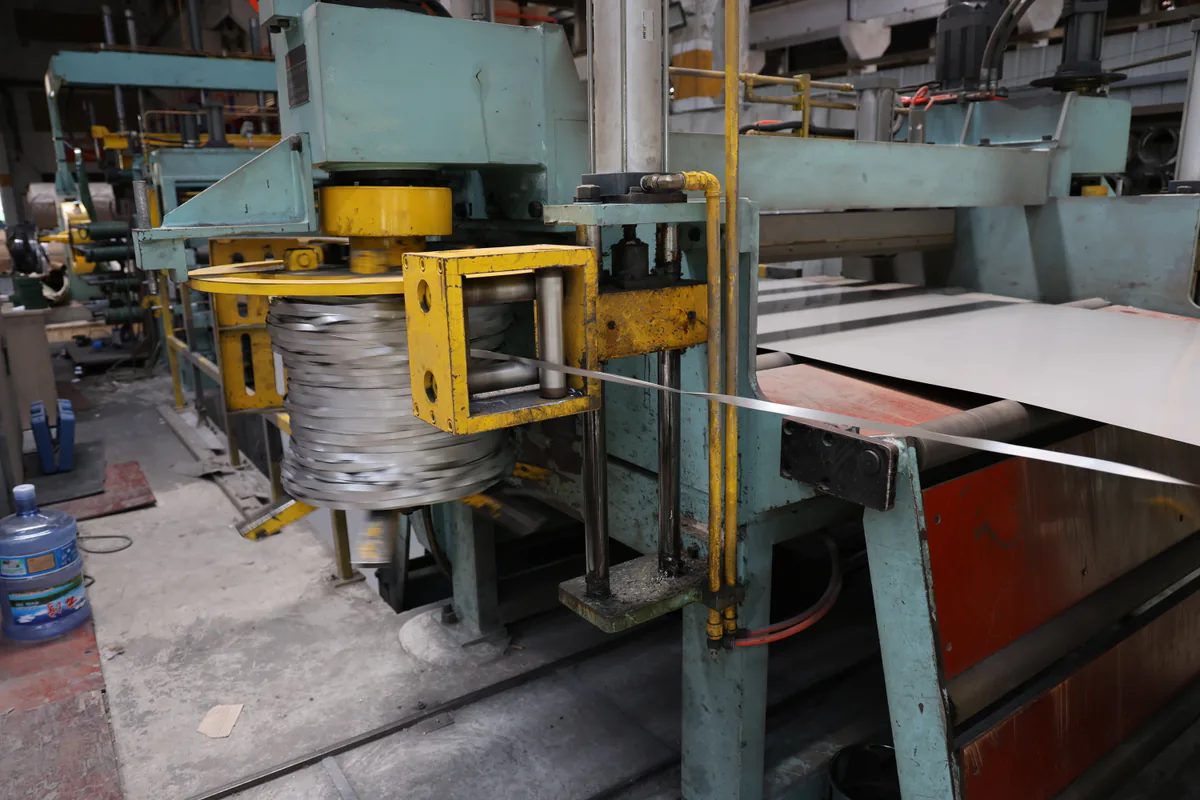

What to send for a 310S slitting quote
A buyer ordering finished 310S narrow strip does not need to design the knife layout. Start with the thickness, each finished width, quantity or finished mass for each width, downstream process and destination. Add the product standard, condition, surface and receiving-line limits if known.
If the mother coil or layout is fixed, add its actual width, coil weight, inside diameter, outside-diameter limit and strand counts. Write 300 mm × 4 strands and 40 mm × 1 strand, not only “1,240 mm total.” Otherwise, leave those fields open so the mother-coil options can be compared with the required quantity mix.
Hechuang supplies cold-rolled coil from 0.25 to 8 mm, hot-rolled coil from 3 to 16 mm and flat products up to 2,500 mm wide. The quotation must still confirm the 310S mother coil, slit combination, tolerance and processing method.
Use the 310S coil page for mother-coil details and the 310S strip page for finished narrow strip.
Build the width map from confirmed layout width
The ordered coil width is not automatically available for finished strips. In this guide, confirmed layout width is the actual cross-coil width used to plan the layout after reviewing the incoming width, edge condition and known unusable areas. Side trim, unusable edge, intentional remnant and other reservations remain separate.
Calculate the nominal finished-width total as follows:
Finished-width total = Σ(number of strands × nominal slit width)
Then compare it with the confirmed layout width:
Planned residual width = confirmed layout width − finished-width total
The planned residual width must be allocated to side trim, an intentional remnant or another reservation. Feasibility also depends on the incoming edge, defects, width variation, knife and spacer arrangement, material condition and processing method.
Illustrative width plan
This example demonstrates the arithmetic only. It is not a customer order, production record or guaranteed layout.
| Input | Example value |
|---|---|
| Confirmed layout width | 1,250 mm |
| Finished-width plan | 300 mm × 4 strands plus 40 mm × 1 strand |
| Finished-width total | 1,240 mm |
| Planned residual width | 10 mm |
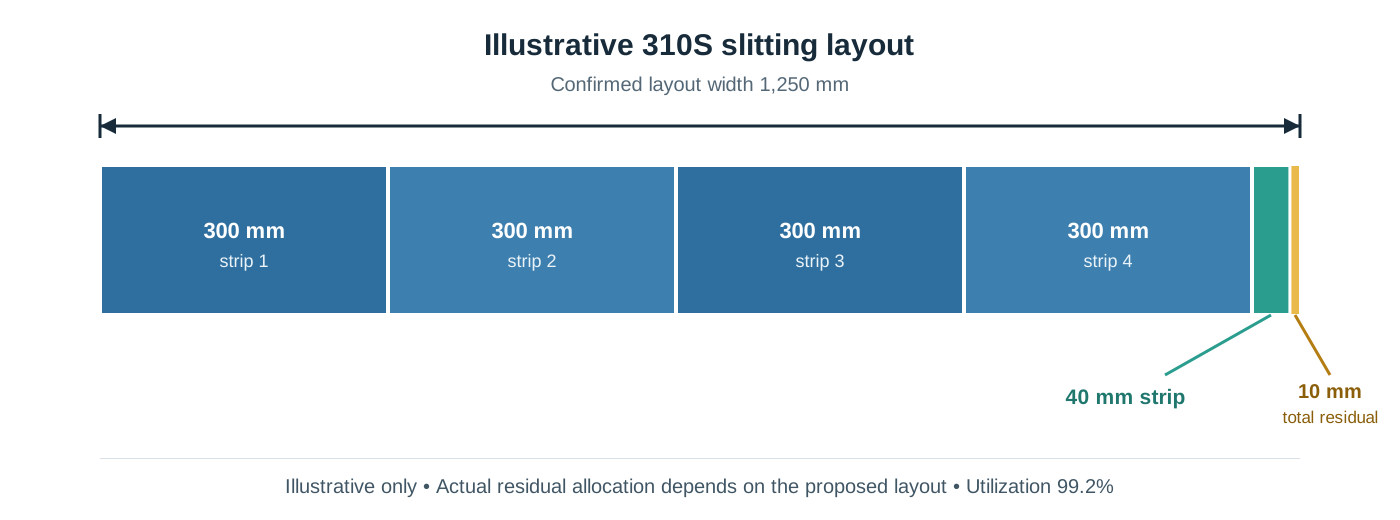
The nominal layout utilization is 1,240 ÷ 1,250 × 100% = 99.2%. This is a width-based planning figure, not a guaranteed finished-mass yield.
The layout also fixes the nominal output mix. If all strips have the same grade, thickness and usable length, and differences in dimensions or losses are ignored, the four 300 mm strips and the single 40 mm strip have a nominal mass ratio of (300 × 4) : 40 = 30 : 1. High width utilization can therefore produce the wrong quantity mix.
The diagram places the total 10 mm residual on one side only to show the arithmetic. Its actual allocation depends on the proposed layout. If it is insufficient, the plan needs a different mother-coil width, strand combination or finished-width mix. Head, tail, sample and rejected-material losses remain outside this width calculation.
What Hechuang reviews before quotation
For an initial review, Hechuang separates confirmed buyer requirements from layout assumptions. We check whether the widths and quantities can be matched to a practical mother-coil and strand plan, compare the nominal output ratio with the required quantity for each width, and list the acceptance or coil-handling inputs still needed for a firm quote. Final values depend on the approved material and processing method.
Set width tolerance with a measurement plan
There is no single slit-width tolerance for every 310S order. The feasible limit depends on the product standard, thickness, condition, mother-coil shape, finished width, strand count, edge requirement, processing method and inspection method.
Standards note
ASTM A480/A480M-25b provides general requirements used with ASTM A240/A240M and other listed flat-rolled stainless specifications. The product specification prevails where requirements conflict, and an order may add stricter requirements without waiving the governing specification. State the edition and use either SI or inch-pound values as an independent unit system.
For orders using ISO dimensional standards, ISO 9445-2:2009 includes cold-rolled material below 600 mm when it is produced by longitudinally slitting wide strip. ISO 9445-1:2009 directs that product back to Part 2. ISO 9445-2 lists 0.30–8.0 mm thickness and 600–2,100 mm rolling width, so the production method and dimensional scope must both match; Hechuang’s broader supply ranges are not all within this standard.
A complete width requirement should answer four questions:
| Requirement | What to write |
|---|---|
| Size | Nominal width for each strand or finished coil |
| Limit | Symmetrical tolerance or separate minimum and maximum values |
| Measurement | Gauge type, distance from the head or tail, number of positions and any condition for laying out the strip |
| Handling | How out-of-tolerance strip will be handled: rejected, segregated, reworked or submitted for concession |
If width is critical to stamping, roll forming or welding, include the tooling or feed requirement so it can be reviewed with burr, camber and coil presentation.
Define burr limit and orientation
A burr is the ridge or residual material left outside the intended edge geometry after cutting. The AISI glossary and ISO 10209 define the term, but neither sets a universal 310S acceptance limit.
If burr affects feeding, operator safety, welding, sealing or the finished edge, state:
- the limit or agreed edge-condition description and measurement method;
- the permitted burr face or direction and winding orientation;
- sample frequency and how strip that fails inspection will be handled;
- any deburring, edge conditioning or added protection.
Avoid “burr-free” unless the edge treatment and verification method are defined. Further conditioning can change cost, width and lead time.
Define camber over an agreed length
Camber is lateral curvature along a strip edge. A numerical limit is incomplete without a gauge length and measurement condition.
Write maximum [X] mm over [Y] mm gauge length, then define:
- the support condition and straight reference;
- measurement locations and sample frequency;
- which edge controls and how failed strip will be handled.
Specify crossbow, edge wave, centre buckle or coil set separately if they affect the next operation.
Separate layout utilization from accepted mass yield
Buyers often use the word yield for two different calculations. Separate them before comparing quotations.
Width-based layout utilization
This planning ratio shows how much of the confirmed layout width is assigned to nominal finished strips:
Layout utilization = finished-width total ÷ confirmed layout width × 100%
It compares width combinations. It does not include head and tail losses, samples, defects, rejected strip or mass differences.
Accepted mass yield
In this guide, accepted mass yield is calculated as follows:
Accepted mass yield = accepted finished strip mass ÷ agreed input mass charged to the job × 100%
Illustrative figures only: if the agreed input mass is 10,000 kg and the accepted finished strip weighs 9,800 kg, the accepted mass yield is 9,800 ÷ 10,000 × 100% = 98.0%. Calculate it separately from the 99.2% width-based layout utilization above. The 98.0% figure is not a Hechuang production record or typical yield.
The quotation should state what its input and accepted-output masses include, particularly:
- side trim, reusable remnants and other planned width loss;
- setup ends and inspection samples;
- strip rejected for surface or dimensional nonconformance;
- scrap value, returned material and weight reconciliation.
These are procurement definitions, not standard-mandated formulas or a guaranteed Hechuang yield. Use the same boundaries when comparing suppliers, percentages or prices.
Keep the acceptance plan tied to the finished strip
The inspection plan should follow the characteristics that matter to the next process:
| Characteristic | Order input | Acceptance evidence to agree |
|---|---|---|
| Material identity | 310S designation, product standard and edition, condition and surface | Material certificate and heat or lot traceability required by the order |
| Finished width | Nominal width and upper or lower limits for each slit | Instrument, gauge locations, sample frequency and recorded values |
| Burr | Limit or edge description, permitted face or direction, and any conditioning | Measurement or visual method, sampling and how strip that fails inspection will be handled |
| Camber | Maximum deviation over a stated gauge length | Layout condition, straight reference, locations and recorded result |
| Surface | Protected side, scratch or indentation criteria and handling requirement | Agreed inspection lighting, sample or visual acceptance method where needed |
| Yield | Layout-utilization basis and what is included in the mass-yield calculation | Input weight, accepted output weight and treatment of trim, samples, rejects and remnants |
Coil inside diameter, outside-diameter limit, target coil weight and winding presentation may also control whether the strip suits the receiving line.
Use our processing overview to describe the required conversion sequence. The stainless steel coil calculator can estimate coil weight or length from agreed dimensions and density, but it does not predict processing loss or guarantee finished yield.
Illustrative 310S slitting enquiry
Use this expanded template when acceptance or coil-handling requirements are already defined. It is not a real customer order or production record.
Material: ASTM A240/A240M-26 Type 310S, with the applicable ASTM A480/A480M-25b general requirements. Cold-rolled condition and agreed surface.
Unit system: SI. Specify the M designations: ASTM A240M-26 and ASTM A480M-25b.
Thickness: [value] mm. Required strip: [width A] mm, [quantity or mass], and [width B] mm, [quantity or mass].
Mother coil, if already selected: [actual width] mm, [coil weight] kg, ID [value] mm. Proposed strand counts: [add only if fixed]. Show the layout width and proposed trim allocation before processing.
Finished-width acceptance: [minimum] to [maximum] mm, measured by [method] at [locations and frequency].
Burr acceptance: [limit or edge description], permitted on [face or direction]. Measurement method: [method and frequency]. Edge conditioning, if required: [process and acceptance].
Camber: maximum [X] mm over [Y] mm by the agreed method.
Yield basis: quote the layout-utilization calculation separately from accepted mass yield, and state the treatment of side trim, head and tail, samples, rejects and reusable remnants.
Other requirements: traceability, inspection records, destination and target dispatch date.
Leave unknown fields open. Hechuang can identify the missing inputs before quotation.
Send your 310S strip requirements
Send the thickness, strip widths, quantity for each width, downstream process and destination. Hechuang can review the mother-coil and layout options, compare the planned output mix and identify what is still needed for a quotation. Add fixed strand counts or acceptance limits if available.
Frequently asked questions
Can the finished width total equal the full mother coil width?
It can match arithmetically, but edge condition, side trim, defects, tooling and tolerance can still make the layout impractical. Width closure also says nothing about head, tail, sample or rejected-material loss.
Should width tolerance be written as plus or minus?
Use the format required by the standard, drawing and downstream process. Separate minimum and maximum limits are clearer when one side controls feeding or fit; always add the measurement and sampling method.
Is burr direction important for a 310S slit coil?
Yes, when one face contacts tooling, a seal, a forming surface or an operator. State the permitted burr face, winding orientation and any edge conditioning.
How should camber be written on the order?
State the maximum lateral deviation over a defined gauge length, plus the support condition, straight reference, sampling and how failed strip will be handled.
Is theoretical layout utilization the same as material yield?
No. Width-based utilization compares assigned widths with layout width. Accepted mass yield compares accepted output mass with the agreed input mass and can include losses that the width calculation cannot show.
Can the coil calculator predict slitting yield?
No. It estimates theoretical weight or length from dimensions and density, not trim, setup loss, samples, defects, rejects or remnant treatment. Use the result to check quantity assumptions, then obtain a processing-specific yield basis.
Technical Sources
Technical references apply to the material designation, product form and condition described here. They do not certify an individual delivery; the order and material certificate identify the supplied material.
- ASTM International — ASTM A240/A240M-26
- ASTM International — ASTM A480/A480M-25b
- International Organization for Standardization — ISO 9445-1:2009
- International Organization for Standardization — ISO 9445-2:2009
- American Iron and Steel Institute — Steel Industry Glossary
- International Organization for Standardization — ISO 10209:2022
Send Your 310S Strip Requirements
Send the thickness, finished widths, quantity for each width, downstream process and destination. We will review mother-coil and layout options and identify missing acceptance details before quotation.