
The verified identifiers used in this guide are Type 310S / UNS S31008 and EN 1.4845. For plate, sheet and strip ordered to ASTM requirements, pair Type 310S with ASTM A240/A240M-26. Nippon Steel also lists 310S, SUS310S and S31008 together in a chemical-industry seamless pipe and tube product table; that is useful product-scoped JIS/ASTM naming evidence, not automatic equivalence for every form. The grade name alone is not a complete purchase description: add the product standard, form, dimensions, condition and inspection requirements.
Quick Facts for Buyers
- Grade identity
- Type 310S / UNS S31008 · EN 1.4845
- ASTM flat-product scope
- ASTM A240/A240M-26 covers stainless plate, sheet and strip
- ASTM 309 / 310
- The ASTM flat-product standard includes Type 309 and Type 310
- What to send for a quote
- Designation + product standard + form + dimensions + quantity
- Current ISO edition
- ISO 15510:2014 · confirmed in 2025
- JIS pipe/tube example
- 310S · SUS310S · S31008

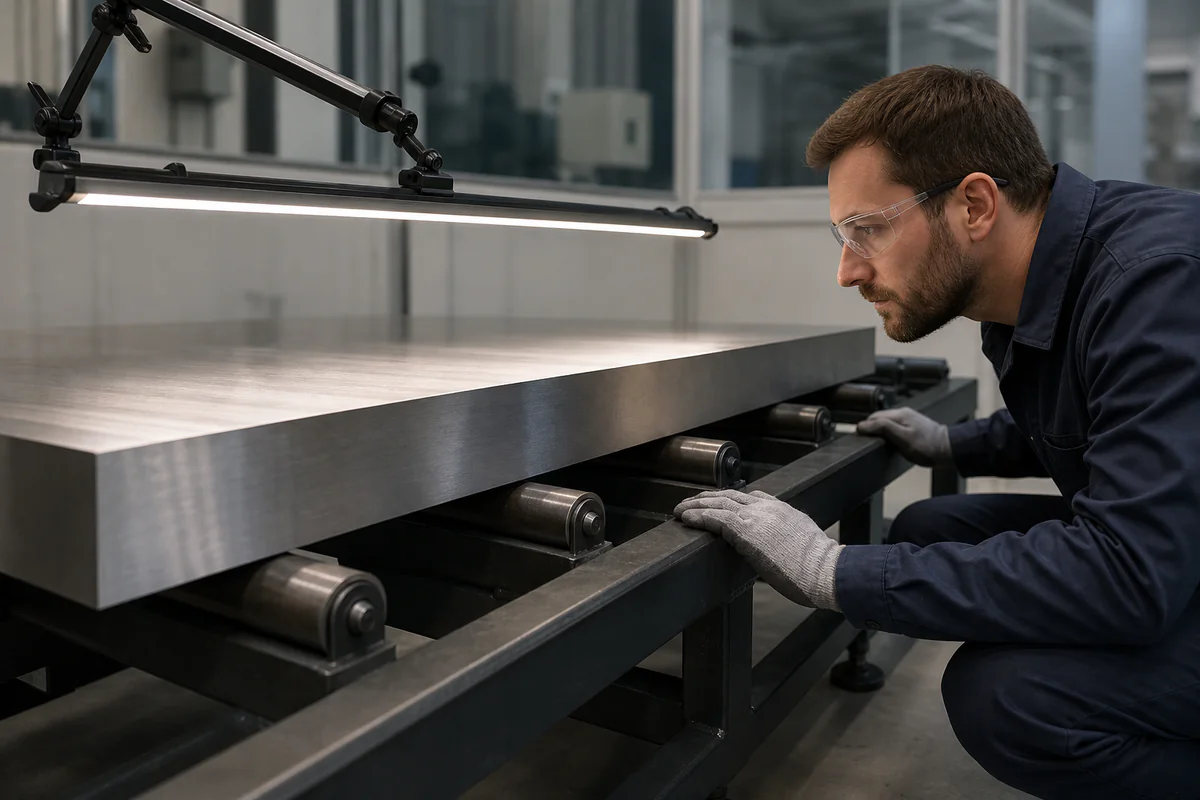
Read the designation together with the product standard
The short answer is straightforward: use Type 310S / UNS S31008 for the verified ASTM/UNS
identity in this guide, or EN 1.4845 when the project specification uses the EN material
number. For ASTM plate, sheet or strip, write ASTM A240/A240M-26 Type 310S before adding the
dimensions and delivery requirements. For a verified JIS naming example, Nippon Steel’s
chemical-industry seamless pipe and tube table lists 310S, SUS310S and S31008 in one
product row. This supports that named pipe/tube context; it does not make all product standards
or forms interchangeable.
A grade identifier and a product standard answer different purchasing questions. The identifier
names the material. The product standard defines the product scope and the requirements
that apply to the ordered form. A line that says only 310S does not state whether the item is
plate, sheet, strip, tube, bar or a finished fabrication, and it does not define condition,
dimensions, testing, tolerances or inspection documents.
Current standards information provides a safe starting boundary. ASTM identifies ASTM A240/A240M-26 as its current specification for chromium and chromium-nickel stainless plate, sheet and strip for pressure vessels and general applications. The grade information used here identifies Type 310S / UNS S31008 and EN 1.4845. Those details do not convert every product form or national system into one interchangeable item.
Before sending the enquiry, identify which document has design authority: drawing, material specification, equipment code, customer standard or another controlled requirement. If those documents disagree, raise the conflict instead of choosing the most familiar name. The supplier can confirm what can be supplied, but the purchaser or design team must decide which standard and designation the project accepts.
In practice, many enquiries arrive with only a grade name or material number in the material field. Before we price them, we ask whether the requirement is plate, sheet, strip, tube, bar or a finished part; which standard and edition controls; what condition and dimensions are needed; and which inspection document must be supplied. Those four points usually determine whether two quotations are genuinely comparable.
Product / condition: Designation and ordering guidance. This table is not a merged chemistry, mechanical-property or dimensional specification.
Applicability: Use it to structure an enquiry. The approved drawing, purchase order, governing product standard and edition remain the acceptance basis.
310S ordering routes and buyer controls
Standards system Ordering detail Buyer action ASTM / UNS Type 310S / UNS S31008; ASTM A240/A240M-26 is the current flat-product specification. Add form, dimensions, condition, finish, tolerances, tests and document requirements. EN EN 1.4845 is the associated designation. State the applicable EN product standard and edition rather than treating the material number as a complete order. JIS pipe/tube example and other systems Nippon Steel lists 310S, SUS310S and S31008 in a chemical-industry seamless pipe/tube product table. Use that row only in its product context. For JIS, GB or another route, copy the actual designation, product standard and edition into the order. Cross-system comparison ISO 15510:2014 is current and was confirmed in 2025. Obtain the standard itself for detailed rows; do not infer equivalence from the public abstract.
Product Standard Versus Grade Designation
What the designation does
The designation helps purchasing, engineering, the mill and inspection team talk about the same intended material. It belongs on the RFQ, quotation, purchase order, product marking where applicable and MTC. A mismatch among those places is a document-control issue even when a single reported chemistry value appears plausible.
The designation does not by itself define the full acceptance envelope. It does not tell the supplier which product form is required, which dimensional standard applies, whether solution annealing is required, which surface finish is acceptable, which tests are mandatory or what inspection document must accompany the shipment.
What the product standard does
The product standard connects the grade designation to a specific product form. Its scope matters. ASTM A240/A240M covers plate, sheet and strip; it is not a universal label for tube, pipe, bar, forging, fittings or fabricated assemblies. Those forms need their own applicable standards and grade availability review.
The edition also matters because requirements can change. Put the edition in the purchase description when the project requires a fixed edition. If the buyer permits the supplier to propose the latest edition, record that rule in writing and resolve any difference before order acceptance. The order, not a website summary, controls the delivered acceptance criteria.
ASTM / UNS
Build the ASTM flat-product line
For a flat-product enquiry, a clear purchase description begins with ASTM A240/A240M-26 Type 310S and may add
the producer-published UNS identifier S31008. Continue with plate, sheet or strip; nominal and
ordered dimensions; quantity; condition; finish; edge; flatness or other applicable tolerances;
marking; inspection document; required tests; and any supplementary requirements.
ASTM’s public catalogue establishes the current specification title and scope. The detailed standard must be reviewed for the requirements that apply to the actual product. Do not treat the catalogue page as a replacement for the purchased standard, and do not copy a flat-product specification onto a tube or bar order.
Keep Type and UNS connected to the order
The grade information used here identifies Type 310S / UNS S31008 together. This designation pairing
does not prove that any document marked only
S31008 meets every requirement of an ASTM A240/A240M-26 order.
Incoming review should match the ordered Type or UNS designation, product standard and edition, form, dimensions, condition and heat identification across the MTC and goods. If a quotation shortens the description, ask the supplier to restate the complete offered specification before acceptance.
EN
Use EN 1.4845 within its product context
EN 1.4845 appears with 310S in the grade information used here. This is useful for a buyer who receives a drawing or quotation using the EN material number. That identifier alone is neither a complete EN purchase description nor evidence that an ASTM product can be accepted without reviewing the relevant standards and project specification.
An EN enquiry should state the exact material designation required by the approved project documents, the applicable EN product standard and edition, form, dimensions, condition, tolerances, testing and inspection-document requirement. If the steel name is required by the project, take it from the current governing standard or approved specification, not from a withdrawn comparison chart.
Control mixed-system quotations
When a drawing says EN 1.4845 and a supplier proposes an ASTM or UNS designation, treat the proposal as a controlled alternative. Ask for the full offered standard and edition. Engineering should compare scope, chemistry, properties, heat treatment, dimensional rules, testing, marking and documentation. The final order should identify which system controls acceptance.
A note such as “310S equivalent” is not enough. It transfers a technical decision to receiving inspection, where the material may already be produced or cut. Resolve the designation and standard while the quotation can still be changed.
JIS and Other Systems
Use the verified JIS example within its product scope
Nippon Steel’s official chemical-industry seamless pipe and tube catalogue provides a useful
product-scoped naming example. Its 310S row lists the product name 310S, the JIS example
SUS310S and the ASTM/ASME example S31008. This answers the naming question for that table;
the requirements can still differ between the governing JIS and ASTM product specifications.
For an actual JIS enquiry, send the complete purchase line and drawing revision. The order still needs the applicable JIS product standard and edition, form, dimensions, condition, tolerances, tests and inspection document. A seamless pipe/tube catalogue row should not be copied onto a plate, bar, forging or fabricated-part order without checking the standard that governs that form.
If a drawing requires a JIS-based order, copy the exact designation and product standard from the approved drawing, material specification or current JIS document. Ask the supplier to confirm that exact specification for the required product form. If the offered document uses another system, send it back for engineering comparison rather than rewriting the name on the RFQ.
Order the specified national-standard product, not a translated nickname
State form, dimensions, condition, surface, tolerances, testing, marking and documentation in the same way as for other systems. A cross-reference may help communication, but it should sit in a note and should not replace the governing JIS purchase line.
At receipt, inspect the marking and MTC against the exact description on the order. The same rule applies when a project specifies GB or another national system: copy the approved designation, product standard and edition, and ask us to quote that route directly. The available evidence in this guide does not justify inventing a GB cross-reference from an ASTM, JIS or EN identifier. If the certificate uses only a commercial nickname, obtain clarification and formal disposition before the material is released.
Quote the GB requirement shown on the project documents
The same evidence boundary applies to GB. ISO’s public page confirms the current ISO edition and abstract scope, including that Chinese GB standards are among the bases considered. It does not publish the detailed designation rows. This guide therefore does not assign a GB name to 310S.
For a GB-governed project, obtain the exact designation, product standard and edition from the approved technical specification. Put them together in the RFQ. Ask the supplier to identify the offered GB specification, product form, condition and inspection documentation without substituting an ASTM or EN shorthand.
Keep acceptance in one system
If procurement wants to compare a GB specification with the current producer-published ASTM/UNS or EN option, engineering should review the complete standards. Record which option is approved and which standard controls acceptance. Do not create a hybrid order that names one system while testing and documenting another without written rules.
Receiving inspection should be able to trace one approved description from order to marking and MTC. When that chain is unclear, quarantine the affected material and resolve the discrepancy before cutting, fabrication or shipment to the project site.
Substitution Control
Define who may approve a change
A substitution rule belongs in the enquiry. State whether alternatives are prohibited, allowed only after written approval, or permitted within a defined list of standards and designations. Name the purchaser or design team that can approve the final specification. A sales note or verbal agreement should not override the drawing.
The technical review should compare product scope, chemistry limits, mechanical requirements, heat treatment, dimensions, tolerances, testing, marking and inspection documents. It should also consider the actual service and fabrication plan. Similar grade names do not demonstrate component suitability or contractual equivalence.
Freeze the approved specification before work starts
Any approved change should appear in the revised quotation and purchase order before material is reserved, cut or fabricated. The supplier should identify deviations and assumptions clearly. Purchasing should not accept an unmarked “equivalent” line and rely on the MTC to explain it later.
Keep the approval record with the order file. Incoming inspection then has a clear basis for checking the goods. If the supplied designation differs from the approved specification, stop release and obtain documented disposition.
Purchase-Order Wording
Use a complete line-item structure
A reusable purchase line can be organized as:
[governing product standard and edition] [exact grade designation] [product form], [dimensions and tolerances], quantity field: [quantity], [delivery condition and finish], [processing], [marking and traceability]; inspection-document requirement: EN 10204 3.1, subject to supplier confirmation before order acceptance; [required tests and reports], [third-party inspection scope], [packing and delivery terms].
Square-bracket fields are inputs to complete for the real enquiry, not claims about an existing order. Keep the units explicit. If several line items use different forms or standards, repeat the controlled identity on each line instead of placing one ambiguous note at the top.
State exceptions before acceptance
Ask the supplier to list every deviation in the quotation. Silence should not be treated as approval of a different standard, condition or document requirements. If an EN 10204 3.1 inspection document is required, state it explicitly and obtain confirmation for the actual mill and product specification.
Link drawings by number and revision. Define finished-part tolerances separately from mill product tolerances. Add the required language, number of document copies, electronic delivery timing and any original-document requirement.
MTC Alignment
Match the material identity
The MTC should describe the material actually supplied under the order. Check issuer, purchase description, grade, product standard and edition where stated, form, nominal dimensions, condition, heat or lot references and reported results. Match those identifiers to product marking, packing records and the purchase order.
A low carbon value on a document does not by itself prove the complete 310S specification. Acceptance depends on compliance with the ordered standard and the traceability of the results to the supplied product. Likewise, a familiar grade name does not cure the wrong form or standard.
Resolve mismatches before release
Create a discrepancy record when the quotation, order, marking or MTC does not align. Identify the affected material, preserve traceability and ask the responsible technical authority for a documented decision. Do not rewrite the certificate, relabel the material or accept a cross-system substitution without approval.
For the document requirements to include with the enquiry, use the 310S MTC and RFQ checklist. The 310S grade page and 310S plate page provide the related material and product-form details.
Align the Designation, Order and MTC
A controlled designation workflow
Before comparing prices, align the designation and documents in this order:
- Freeze the drawing revision, component function and permitted material system.
- Identify the exact designation, product standard, edition and product form.
- Complete dimensions, condition, finish, tolerances, processing and inspection documents.
- Ask each supplier to state the offered specification and every deviation.
- Send proposed substitutions to the named project approver.
- Carry the approved identity into the purchase order, marking plan and MTC request.
- Match the delivered goods and documents before release.
Use this workflow to keep standards translation, marking and documents aligned from RFQ through receiving and to prevent an undocumented material change.
Where a project uses JIS, the verified Nippon Steel seamless pipe/tube row can help identify the SUS310S naming route, but the current governing JIS product standard still controls the order. Where a project uses GB or another system, obtain the exact approved designation and product standard instead of converting from a commercial cross-reference. In every case, the ordered product standard controls acceptance.
Conclusion
310S naming becomes procurement-ready only when the designation, product standard, edition and product form are written together. Current evidence supports Type 310S / UNS S31008 and EN 1.4845 as grade identifiers, while ASTM A240/A240M-26 supplies the current flat-product specification.
For JIS requirements, the product-scoped Nippon Steel table supports SUS310S as the JIS example for its chemical-industry seamless pipe/tube row. For GB and other systems, we quote the exact approved designations and product standards stated in the project documents. ISO 15510:2014 is the current edition confirmed in 2025; the applicable product standard and purchase specification control the designation used for the order.
Summarize the exact specification, form, dimensions, condition, processing, requested inspection documents and substitution rules in the RFQ. Send your dimensions and requirements through the full RFQ form; drawings and specifications can be attached optionally. Require deviations before acceptance and keep the approved description aligned through purchase order, marking and MTC.

Frequently asked questions
Do Type 310S and UNS S31008 identify the same grade?
Yes. Type 310S and UNS S31008 identify the same grade. The order must still name the applicable product standard, edition, form, condition, dimensions and inspection requirements.
Can I order EN 1.4845 under ASTM A240/A240M-26 without defining the acceptance basis?
Do not mix standards without defining the acceptance basis. State the permitted designation and governing product standard for the offered material. Obtain written engineering approval before accepting a substitution between standards.
Which JIS designation should I use for 310S?
For one verified product context, Nippon Steel lists 310S, SUS310S and S31008 in its chemical-industry seamless pipe and tube table. Use that row to identify the naming route, then state the actual JIS product standard, edition, form and condition required by the project; do not extend the row automatically to plate, bar or every other form.
What if the drawing specifies another national system?
Send the exact designation, product standard and edition shown on the project drawing or material specification. We will quote the available form and condition against that purchase description rather than converting an ASTM, JIS or EN name into an unverified equivalent.
How should ISO 15510:2014 be used in a designation check?
Use the catalogue to confirm the edition and scope, then verify any designation relationship against the applicable product standards and the project specification before placing the order.
How should a proposed 310S substitution be handled?
Compare the complete standards, product scope, chemistry, properties, condition, dimensions, testing and documentation. Obtain written approval from the named purchaser or design team before quotation acceptance or manufacture.
Technical Sources
Technical references apply to the material designation, product form and condition described here. They do not certify an individual delivery; the order and material certificate identify the supplied material.
Build Your Enquiry
Open the relevant grade and product pages, then send the exact designation, standard, form, dimensions, quantity, processing and inspection scope to the sales team.