
For a quick 310S stock enquiry, send the grade, product form, dimensions, quantity and destination; unknown document details can be marked “please advise.” The four document decisions specific to the proposed supply are whether existing stock already has the required document, how heat identity will transfer to cut parts, how multiple heats or partial shipments will be documented, and whether a late EN 10204 3.1 request changes the stock or cutting option. Confirm these points before order acceptance. Use the general MTC guide for certificate types and review fields, and the general RFQ guide for the full technical and commercial checklist.
Quick Facts for Buyers
- 310S grade identity
- Type 310S / UNS S31008 · EN 1.4845
- ASTM flat products
- ASTM A240/A240M-26 · plate, sheet and strip
- Document request
- Write EN 10204 3.1 explicitly when required
- Traceability chain
- Heat or lot · marking · packing · delivered goods
- Minimum quick enquiry
- Grade · form · dimensions · quantity · destination

Build the document requirement into the RFQ
For a normal stock-size enquiry, do not wait until every engineering field is complete. Start with 310S, the product form, dimensions, quantity and destination. We can then tell you which stock or supply option is available and which document package can be confirmed for it.
For a controlled project order, documentation becomes part of the product definition. “310S plate with MTC” still leaves the inspection-document type, results, traceability, language and delivery timing open. Those items should be settled before the material is allocated.
Start with the complete material identity: exact grade, product standard and edition, product form, dimensions, delivery condition, finish, tolerances and quantity. Then define the document package. State whether EN 10204 3.1 is required, which chemistry and mechanical results must be reported, how heat or lot identity is preserved, what markings are needed, and whether a third party must witness or review any step.
DIN EN 10204:2005-01 defines types of inspection documents for metallic products. Its catalogue page supports the document-type context. The ordered standard itself and the purchase order control the detailed requirement.
Our general MTC guide explains document types, issuer roles and document review. This page stays focused on what a 310S buyer should put into the enquiry and order.
Four common 310S scenarios drive that decision. For stock material, ask whether the existing inspection document identifies the offered grade, form, dimensions and heat or lot. For cut parts, define the marking transfer or material map before the original marking is removed. For orders using multiple heats, require shipment-level document links so partial shipments do not mix evidence. A late EN 10204 3.1 request may rule out an otherwise suitable stock or already-cut route because document type and specific inspection results cannot be created merely by relabelling existing paperwork.
The most common timing problem we see is a buyer asking for a specific inspection document after material has already been reserved or cut. We therefore check the document type, required test results, traceability level and any witness points before quotation. This gives the supplier time to confirm what the producing mill can issue instead of trying to repair the paperwork later.
Assign responsibilities at the same time. Engineering defines the material and acceptance basis; purchasing carries it into the order; the supplier confirms the offered document package; quality reviews the received evidence; and receiving keeps the goods on hold until the required checks are complete. When responsibility is left implicit, document gaps can be discovered only after shipment or processing.
Stock 310S and Existing Documents
Define every link before order acceptance
A complete document chain connects the purchase decision to the physical goods:
- the RFQ defines material and document requirements;
- the quotation confirms the offered mill, product and document requirements;
- the purchase order freezes the accepted requirements;
- the issuer produces the applicable order-specific inspection document;
- heat or lot identifiers connect reported results to the product;
- markings and packing records maintain that identity through delivery; and
- receiving inspection matches the documents to the goods before release.
A broken link cannot be repaired by a familiar logo or grade name. For example, chemistry results without a matching heat identifier do not prove that the tested heat is the one supplied. A document that describes plate does not cover tube. A sample issued for another item cannot certify a future order.
Keep the order document tied to the supplied 310S
The document supplied for the order should repeat the material identity that was accepted in the quotation: grade, product standard, form, dimensions or size range, condition where applicable, and heat or lot reference. Markings and packing records must carry enough information to connect that document to the delivered 310S.
Document revisions need control as well. State how corrected certificates are identified and which version supersedes the earlier issue. Keep the transmittal date and reviewer decision with the order file. If a certificate is replaced, prevent both versions from circulating as current. This is especially important when documents are shared with a fabricator, inspection agency or end user.
Late 3.1 Requests and Route Changes
Write the type explicitly
If the project requires EN 10204 3.1, put the exact term in the RFQ and purchase order. Do not use “MTC required” as a substitute. Ask the supplier to confirm that the selected mill, grade, product form, dimensions and quantity can be supplied with the requested document type before the order is accepted.
Add the expected language, electronic or original copies, submission timing and any portal or
document-number convention. State whether documents are needed for approval before shipment,
with shipping documents, or both. If the purchaser needs an independent inspection arrangement, define
it separately rather than assuming that 3.1 describes every third-party activity.
Confirm the actual document type
Review the title, type statement, issuer and validation details on the certificate supplied for the order. The public redacted inspection-certificate sample shows a possible field layout; it is not labelled EN 10204 3.1 and is not evidence for a future order.
If a supplier cannot confirm the requested type, ask for the available alternative and its issuer before award. Engineering and quality can then decide whether the project permits a revision. Do not accept a vague promise to “upgrade the MTC later,” because issuer, testing and release arrangements may need to be built into the production method.
Cut Parts and Marking Transfer
Connect heat or lot to each item
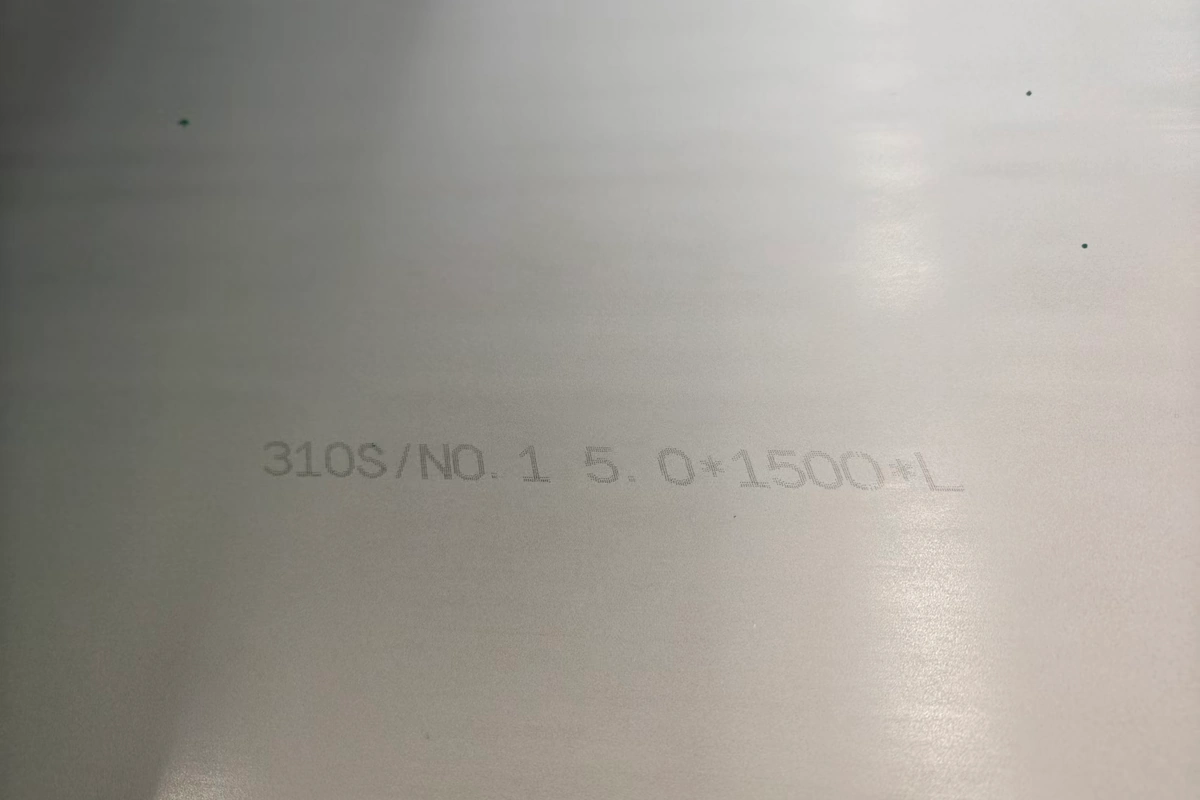
Traceability should be defined at the grain required by the project. State whether the buyer expects heat, lot, coil, plate, bundle, piece or fabricated-part identity. Define marking content, location, transfer method after cutting, remnant control and the records that connect packing units to the inspection document.
For plate or sheet cut into parts, the heat link can be lost if markings are removed without a controlled transfer method. For bundled products, the tag and packing list may become essential links. For fabricated assemblies, a material map may be required. These controls belong in the RFQ because they affect processing and inspection.
Review the chain, not one field
A heat number printed on both an MTC and a plate is useful only when the surrounding identity is consistent. Check grade, standard, form, dimensions and order reference as well. Confirm that the number has not been copied onto a different product form or order line.
The actual order document, markings and packing records must supply the traceability links used at receiving.
Multiple Heats, Results and Partial Shipments
Define what must be reported
State the chemistry and mechanical-result requirements that follow from the governing product standard and any approved supplementary requirements. Identify additional tests only when the project needs them and the supplier confirms feasibility. Do not turn producer typical values or a sample result into contractual targets.
When the quantity is supplied from multiple heats or in partial shipments, require each packing unit and shipment line to identify the applicable heat and document. Do not use one convenient certificate as a blanket file for material from other heats. Decide whether the buyer needs a shipment-level set, a final consolidated index or both.
Take acceptance limits and required tests from the ordered product standard and project specification. Keep typical producer data separate from order acceptance values.
Review units, methods and applicability
Compare each reported result with the ordered standard and edition. Check units, test temperature, specimen direction, thickness or size applicability, heat-treatment condition and any footnotes. A number can appear within a familiar range while still being reported for the wrong condition or product.
If a required result is missing, unclear or not applicable, raise a technical query. Do not enter an assumed value or copy a number from the public sample. Preserve the original document and record the supplier’s response or corrected issue.
Review consistency within the document too. The material description, heat identifier and test rows should refer to the same controlled item. Repeated values, unexpected unit changes or page headers that do not carry the same document number deserve clarification. These signals do not prove an error, but they justify a hold until the issuer explains the record.
Match 310S Documents to the Goods
Match the described product
The document should describe the same form and nominal dimensions as the goods and order. Check plate versus sheet, strip, coil, pipe or tube; thickness or wall; width or diameter; length; and condition where stated. Confirm that the dimensional record required by the order is present when the MTC itself does not carry finished measurements.
Mill product dimensions and finished-part dimensions are different controls. A material certificate does not prove that drawing-based cutting, machining or fabrication tolerances were achieved. Request a separate dimensional inspection report when the project requires one.
Preserve marking through processing
Define grade, standard, heat or lot, item number and any purchaser-specific marking. State whether stamping, stencilling, tags or low-stress marking is allowed, and where markings may be placed. For cut parts, specify how identity is transferred and how unused remnants are controlled.
At receipt, compare product markings and packing labels with the document and purchase order. If the mark is missing or inconsistent, segregate the material. A matching chemistry table does not compensate for an untraceable item.
Optional Inspection for a 310S Order
Define the activity, not only the agency name
Third-party inspection can include document review, material identification, dimensional inspection, test witnessing, loading supervision or other agreed activities. State the exact scope, acceptance basis, witness or hold points, report format and release authority. Naming an agency alone leaves the work undefined.
Identify who appoints the inspector, who pays, how much notice is required, where inspection occurs and what happens if a hold point is missed. Confirm site access and document availability with the supplier before production. A late request can affect the inspection plan, schedule and cost.
Keep responsibilities visible
Keep an inspector’s report and the manufacturer’s applicable inspection document as separate records unless the order and governing requirements explicitly combine their roles: manufacturer-issued material evidence, purchaser review, third-party witness record and shipping release may be separate items.
If SGS, BV, TÜV, CCIC or another agency is requested, the quotation should confirm the exact organization and scope. Do not claim that inspection has occurred until an order-specific report exists.
Confirm the 310S Route Before Award
Material and document fields
Before accepting the quotation, confirm:
- exact 310S designation, product standard and edition;
- product form, dimensions, condition, finish, tolerances and quantity;
- processing and finished-part drawing requirements;
- exact inspection-document type, including EN 10204 3.1 where required;
- chemistry, mechanical and supplementary result requirements;
- heat or lot traceability and marking-transfer rules;
- dimensional, PMI, NDT or other reports required separately;
- document language, copies, submission method and timing;
- third-party agency, scope, notice and witness or hold points; and
- packing links, destination, Incoterm and required delivery date.
Quotation confirmation
Ask the supplier to state the offered mill or production source where relevant, document issuer, exceptions, assumptions and lead-time basis. Require written confirmation of the requested document type. If the supplier proposes an alternative, send it to the named technical authority before order acceptance.
Confirm the review workflow internally. Identify who compares the results, who checks the goods, who may accept a deviation and who releases the material. Set the filing location and retention rule for certificates, third-party reports, packing records and approvals. A complete supplier package can still become unusable if the buyer cannot find the approved revision or connect it to the received line item.
Use the general MTC guide to prepare the detailed receiving review rather than asking a supplier to copy the layout of a sample certificate.
Carry the 310S Route Through Delivery
Carry the requirement from RFQ to receiving
Use one clear sequence from enquiry to material receipt:
- Engineering freezes the material and product-standard requirements.
- Purchasing adds the exact inspection-document and traceability package.
- Suppliers quote the material and documents together and list deviations.
- The buyer resolves document type, third-party scope and hold points before award.
- The purchase order repeats the accepted requirements.
- Production preserves heat or lot identity through processing and packing.
- Receiving matches issuer, document, results, markings and goods before release.
Apply these steps to the real enquiry and ask the supplier to confirm the producing mill, document package and inspection timing before order acceptance.
The document controls can be scaled to the risk and complexity of the order. A standard stock-size plate enquiry may need a short approval chain, while a fabricated component with transferred markings, additional testing and witness points needs more records. Scaling the process does not change the core rule: every required document must be specified, confirmed, traceable and reviewed before the goods are released.
Use the 310S grade page for material details, the 310S plate page for flat-product inputs and the EN 10204 3.1 guide to prepare the required document checks.
Conclusion
A reliable 310S document package begins in the RFQ. Name the grade, governing product standard, form, dimensions, condition and quantity, then state the exact inspection-document type, traceability, results, marking, third-party inspection and delivery requirements.
Request EN 10204 3.1 explicitly when the project requires it and obtain confirmation before order acceptance. For a straightforward stock enquiry, start with grade, form, dimensions, quantity and destination; we can help identify the remaining supply and document choices.
Before release, match the actual issuer, purchase description, heat or lot, chemistry, mechanical results, dimensions, markings and goods to the purchase order. Resolve discrepancies in writing and keep the management-system certificates held solely by Wuxi Kongfang Metal Products Co., Ltd. separate from order-specific material and inspection documents. Those certificates do not certify Wuxi Hechuang Stainless Steel Co., Ltd. or the Hechuang Stainless Steel brand.
Summarize one consolidated document schedule in the RFQ and require a line-by-line response. That schedule should identify what is submitted for approval, what accompanies the shipment, what is issued after testing and which record controls release. Send your dimensions and requirements through the full RFQ form; drawings and specifications can be attached optionally. When changes occur, revise both the material line and document schedule together. This keeps procurement, quality, the inspector and the supplier working from the same requirement instead of reconciling separate email instructions after production.

Frequently asked questions
What is the minimum information for a 310S stock enquiry?
Send the 310S product form, dimensions, quantity and destination. If the standard, condition or document type is not yet fixed, mark it unknown and ask us to propose the available supply option.
How should EN 10204 3.1 be requested for a 310S order?
State EN 10204 3.1 explicitly in the RFQ and purchase order with the grade, product standard, form, dimensions, required results, traceability, language and inspection scope. Obtain written confirmation before order acceptance.
What should match between the document and delivered 310S?
Match issuer, order reference, grade, product standard, form, dimensions, heat or lot identifiers, chemistry, mechanical results, markings and packing traceability to the purchase order and goods.
What should replace the public sample at receiving?
Use the applicable document supplied for the order and trace it to the delivered heat, lot and product. Compare its fields and results with the purchase order before material release.
When should third-party inspection be defined?
Define the agency, scope, witness or hold points, acceptance basis, report format, timing and cost responsibility before production so access and release can be planned.
Do Kongfang Metal management-system certificates replace a 310S MTC?
No. ISO 9001, ISO 14001 and ISO 45001 concern management systems; they do not report the chemistry or test results of a delivered heat or lot. Use the order-specific material and inspection documents to verify the supplied 310S.
Technical Sources
Technical references apply to the material designation, product form and condition described here. They do not certify an individual delivery; the order and material certificate identify the supplied material.
Build Your Enquiry
Open the relevant grade and product pages, then send the exact designation, standard, form, dimensions, quantity, processing and inspection scope to the sales team.