310S Industrial Furnace Project Solution

Start a 310S furnace enquiry with the operating profile and controlled drawing. Share the furnace atmosphere, continuous and peak temperatures, cycle frequency, load, deposits, component geometry and joining plan. Hechuang Stainless Steel can then organize plate, sheet or pipe-and-tube routes for liners, baffles, radiant-tube parts, supports and formed fabrications, together with cutting, forming, welding preparation, inspection and export packing. This Project Solution gives engineering and purchasing teams one practical checklist for aligning the material route, fabrication sequence, acceptance documents and shipment plan before quotation.

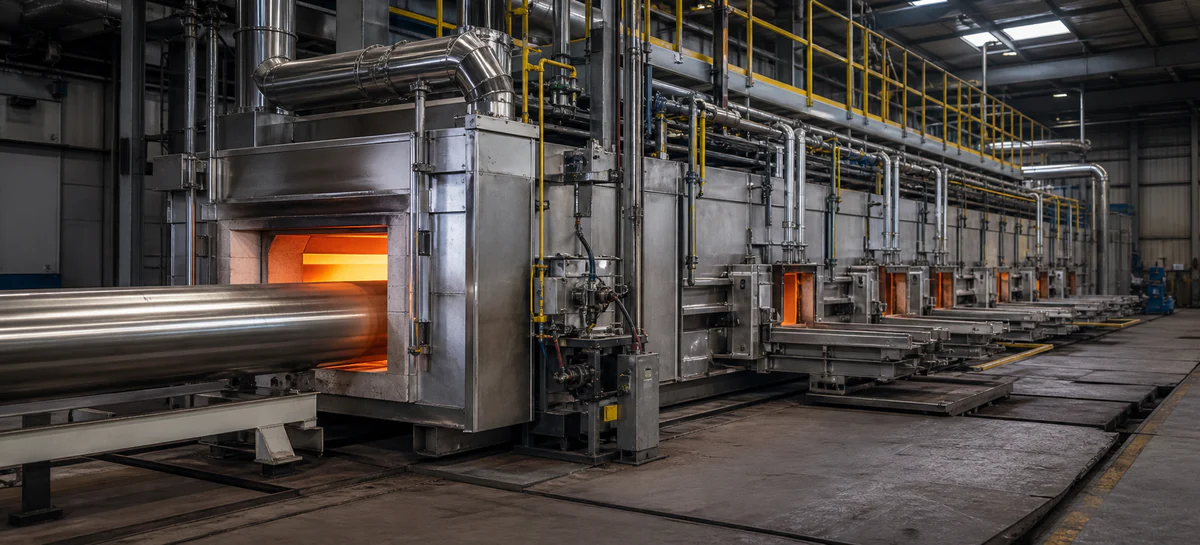
Industrial furnace line with supported radiant tubes and guarded service platforms

Project Planning at a Glance

Grade route
310S · UNS S31008 · EN 1.4845

Source scope: Outokumpu supports the grade identity and cited flat-product context; the ordered product standard controls acceptance.

Selection inputs
Atmosphere · cycle · load · geometry

Source scope: Atlas application and fabrication guidance supports project screening; the project design authority approves suitability.

Flat-product routes
Plate · sheet

Source scope: Outokumpu identifies hot- and cold-rolled coil and sheet plus hot-rolled and quarto plate routes for its 310S product.

Fabrication basis
Drawing · process · acceptance plan

Source scope: ISO cutting and fabrication tolerance frameworks plus published welding-route evidence guide planning without defining finished-part tolerance.

Operating Challenge

Operating Conditions

A furnace drawing shows geometry; a useful material brief adds the environment around it. Identify the component's zone and function, atmosphere on each exposed side, continuous and peak temperature profile, heating and cooling cycle, deposits, cleaning practice, mechanical load, restraint and planned maintenance access. Atlas lists furnace parts among the application contexts for the 310 family, while its guidance also makes clear that atmosphere, design and fabrication inputs matter to selection.

Material review: Use the cited grade and application context to screen 310S, then approve it against the complete operating brief, component design and governing rules.

Typical Furnace Components

Component & Geometry

Use these typical component categories to structure the enquiry. Matching the part function to a product form early helps purchasing, engineering and fabrication teams work from the same drawing and acceptance plan.

Scroll horizontally to review every column.

310S industrial-furnace component planning matrix
Component categoryCandidate product inputInputs to define
Furnace linersPlate or sheetHot-face or backup location, atmosphere, continuous and peak profile, cycling, attachment, expansion allowance and access for replacement.
BafflesSheet or plateGas path, deposits, unsupported span, stiffening, edge detail, attachment method and distortion controls.
Radiant-tube partsPipe or tube with drawing-based connectionsInside and outside atmosphere, OD, wall, length, ends, joint design, pressure or load, test scope and dimensional checks.
SupportsPlate, bar or formed partsLoad, restraint, thermal expansion, section, attachment, machining allowance and inspection points.
Formed fabricationsPlate, sheet or pipe/tube inputsDrawing revision, bend or roll geometry, weld map, tolerance basis, surface condition, assembly sequence and packing split.

State the actual grade, product standard, dimensions, quantity, inspection scope and service conditions in the RFQ.

Candidate 310S Product Forms

Start with the 310S material hub, then open the form route that matches the bill of materials. The order still needs its product standard, dimensions, condition, quantity and inspection scope.

Product context: Outokumpu identifies 310S / UNS S31008 / EN 1.4845 and publishes hot- and cold-rolled coil and sheet, hot-rolled plate and quarto plate routes for its product. Hechuang Stainless Steel matches the requested form to the written RFQ and available supply route.

Drawing & Fabrication Inputs

Material and drawing

  • 310S designation, product standard, condition and source form.
  • Finished geometry, drawing revision, datum scheme and assembly interfaces.
  • Cut edges, holes, machining allowance, bend or roll geometry and surface condition.

Joining and acceptance

  • Joint map, filler responsibility and qualified welding procedure requirements.
  • Heat-input, interpass, cleaning, distortion and sequence controls.
  • Finished tolerances, inspection stages, hold points and repair acceptance.

Fabrication source scope: ISO 9013 provides thermal-cut quality context, ISO 13920 covers general welded-fabrication tolerances, and ISO 2768-1 provides general dimensional and angular tolerance context where individual tolerances are absent. Huaheng supplies a published stainless longitudinal-welding route. These inputs help plan the route; they do not establish finished-part tolerance or replace the drawing, qualified welding procedure and written acceptance criteria.

Inspection & Documentation Plan

Build the inspection plan around the purchase order and drawing. Name the MTC type, heat and item traceability, dimensional report, surface and cut-edge acceptance, PMI, NDT, weld or process records and any third-party witness point. For formed assemblies, identify which dimensions are checked before fabrication, after welding and at final release so the report follows the manufacturing sequence.

Document basis: When EN 10204 inspection documents are required, name the document type in the RFQ and keep product tests, supplementary checks and third-party attendance as separately agreed order requirements.

Packing & Delivery Planning

Group parts by drawing, furnace zone or installation sequence. Define surface and edge protection, capped tubular ends, separators, supports for long or formed items, package weight, lifting points, moisture protection and destination marks. Share container or site-access limits, preservation period, Incoterm, destination and required arrival sequence before the packing plan is finalized.

What to Send for a Quote

Material and service

  • Bill of materials, drawings, revisions and quantities by item.
  • 310S designation, product and dimensional standards, condition and finish.
  • Atmosphere, temperature profile, cycle, load, deposits and component function.

Execution and delivery

  • Cutting, forming, welding, machining and finished acceptance requirements.
  • MTC, traceability, inspection, NDT and third-party witness scope.
  • Packing, destination, Incoterm and requested delivery schedule.

Frequently asked questions

  1. Is 310S automatically suitable for every industrial furnace component?

    No single grade decision covers every furnace. Review the atmosphere, temperature profile, cycling, load, deposits, geometry, joining route and governing design rules before the project authority approves 310S.

  2. What operating information should I send for a furnace-material review?

    Send the furnace zone and component function, gas or process atmosphere, continuous and peak temperatures, cycle frequency, deposits, mechanical load, restraint, cleaning method and planned maintenance interval.

  3. Which 310S product forms can be considered for furnace parts?

    Plate and sheet can be reviewed for liners, baffles, shields, supports and formed sections. Pipe or tube can be reviewed for radiant-path and tubular parts when the product standard, dimensions, ends and test scope are stated.

  4. Can Hechuang Stainless Steel coordinate cutting, forming and welding preparation?

    Yes. Send the drawing and identify cut quality, bend or roll geometry, joint details, machining allowance, WPS/PQR requirements, finished tolerances, surface acceptance and inspection points so a connected fabrication route can be quoted.

  5. What inspection and documentation can be included?

    An enquiry can include the ordered MTC type, heat traceability, dimensions, surface and cut-edge checks, PMI, agreed NDT, fabrication records and third-party witness points. State each requirement before quotation.

  6. What does Hechuang Stainless Steel need to prepare a furnace Project Solution quote?

    Send the bill of materials, drawings and revisions, grade and product standards, dimensions, quantities, operating brief, fabrication sequence, inspection plan, packing requirements, destination and requested delivery schedule.

Reviewed by Hechuang Stainless Steel Technical & Quality Team
Last updated:

Technical References

  1. Therma 310S / 1.4845Outokumpu
  2. Grade Data Sheet — 310 / 310S / 310HAtlas Steels

    Secondary guidance. The ordered standard controls contractual values.

  3. ISO 9013:2017 + Amd 1:2024International Organization for Standardization
  4. ISO 13920:2023International Organization for Standardization
  5. ISO 2768-1:1989International Organization for Standardization
  6. Longitudinal Seam Welding SystemHuaheng Welding
  7. DIN EN 10204:2005-01 — Metallic Products — Types of Inspection DocumentsDIN Media / DIN Deutsches Institut für Normung e. V.

Send your RFQ

Required fields are marked with an asterisk.

Up to 5 files · 10 MB each · 50 MB total. PDF, Office, images, DWG, DXF, STEP/STP and IGES/IGS.

    0 files · 0 MB

    By submitting, you agree that Hechuang Stainless Steel may use these details to respond to your request. Privacy notice.