
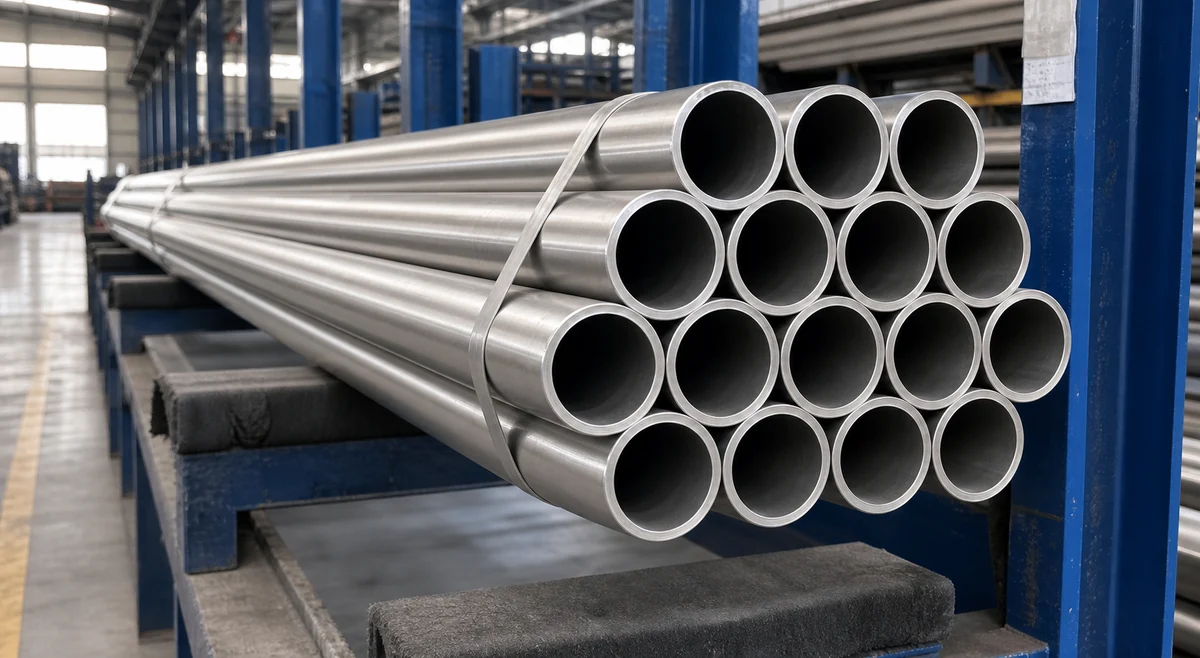
A pipe Schedule identifies a nominal wall thickness only when the nominal pipe size (NPS) and dimensional standard are known. For a given NPS, the outside diameter (OD) stays the same while the Schedule determines the nominal wall and bore. Confirm OD × nominal wall before comparing quotations.
The short answer
- NPS and DN are labels, not measured diameters. Do not assume that an NPS number is the actual OD or that a DN number is an OD in millimetres; the B36.19 NPS/OD relationship changes at NPS 14.
- Schedule needs the pipe size and dimensional standard.
Schedule 40Salone does not identify one wall thickness. - Keep the S suffix. A
40Sdesignation under ASME B36.19 should not be silently changed to40under ASME B36.10. - Confirm OD × nominal wall. These dimensions make the quotation easier to check and provide the correct input for theoretical weight planning.
- Treat pressure and suitability separately. Schedule identifies a dimension series; engineering determines whether the selected pipe is suitable for the service.
NPS, DN, OD and Schedule: How They Fit Together
| Field | What it tells you | What must accompany it |
|---|---|---|
| NPS | A nominal pipe-size designation | The dimensional standard and Schedule or wall basis |
| DN | A paired nominal-size designation where the selected standard uses DN | The mapping in the governing standard or project document |
| OD | The outside diameter of the pipe | Units and whether the value is nominal or measured |
| Schedule | A wall-series designation used with NPS | The NPS and named dimensional standard |
| Wall thickness | The radial thickness of the pipe wall | Units and whether the value is nominal, minimum, average or measured |
These fields are related, but they are not interchangeable. A complete size description should let the buyer and supplier identify the same dimensional-standard row and wall column without guessing.
Why one NPS keeps its OD while Schedule changes the wall
Think of a pipe schedule table as a row-and-column lookup.
The NPS row identifies the nominal pipe size and its table OD. Moving across that same row to another available Schedule column changes the nominal wall thickness. The outside surface stays at the row OD, while a thicker wall reduces the nominal inside diameter.
This leads to three practical rules:
- A Schedule number has no single wall-thickness value across all NPS sizes.
- A higher wall series does not change the table OD for the same NPS, but it changes the nominal wall and therefore the nominal bore and theoretical mass.
- The exact OD and wall must be read from the governing dimensional standard, not from the Schedule label alone.
Schedule numbers are designations, not a linear scale. For example, a Schedule value should not be used as a wall thickness in millimetres, and doubling a Schedule number does not mean that the wall thickness doubles.
Worked dimension example
At NPS 1, the examples below have the same nominal OD but different nominal wall thicknesses.
| NPS | Schedule | Nominal OD, mm | Nominal wall, mm |
|---|---|---|---|
| 1 | 10S | 33.40 | 2.77 |
| 1 | 40S | 33.40 | 3.38 |
| 1 | 80S | 33.40 | 4.55 |
Example values cross-checked against Alleima’s ANSI/ASME pipe dimensions. Confirm order dimensions against the specified edition of ASME B36.19, including applicable errata.
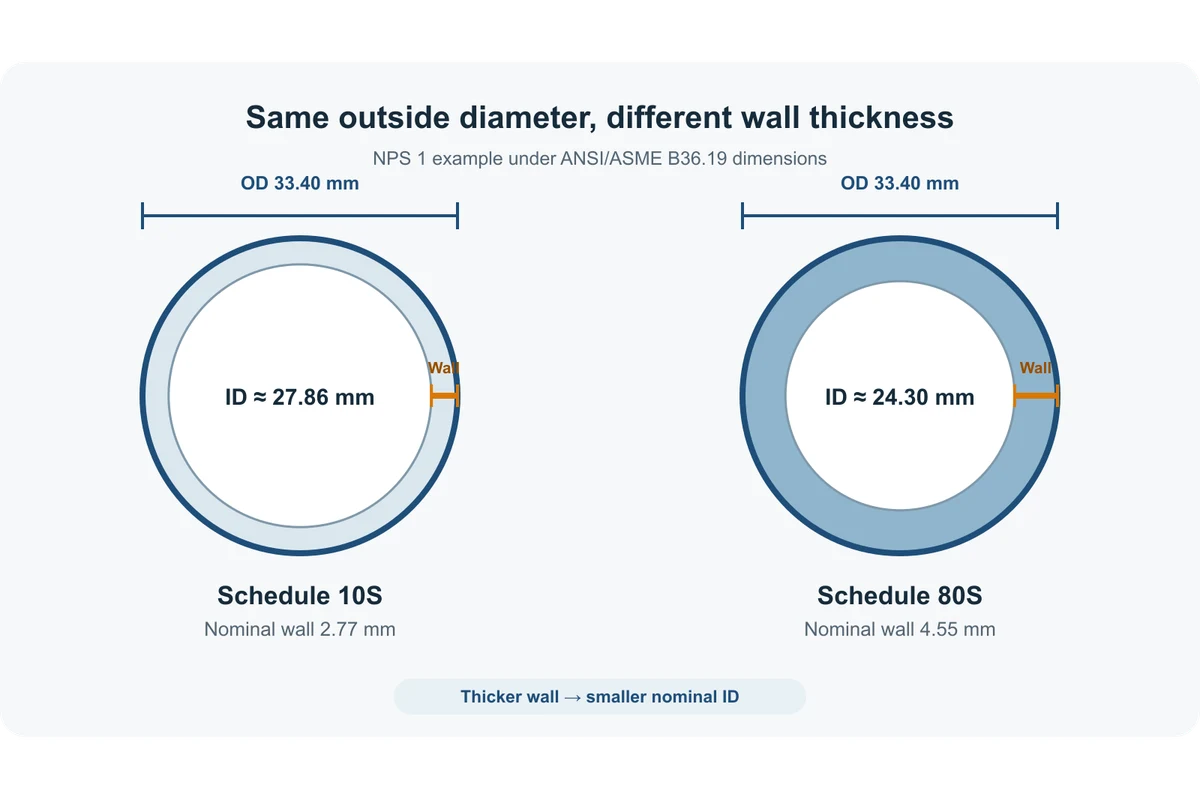
NPS 1 keeps the same 33.40 mm nominal OD in this example. Increasing the nominal wall from 2.77 mm to 4.55 mm reduces the calculated nominal ID from 27.86 mm to 24.30 mm.
The outside diameter stays the same. As the wall gets thicker, the inside diameter becomes smaller.
For a quick geometry check, nominal ID is approximately OD - 2 × wall. That gives about 27.86 mm for the 10S row and 24.30 mm for the 80S row. These calculated IDs explain the relationship; they are not bore-tolerance guarantees.
Why NPS and DN are not unit conversions
NPS is dimensionless. It is not the measured OD, and it should not be converted to millimetres by multiplying the NPS number by 25.4. Under ASME B36.19, NPS 12 and smaller do not numerically match the OD in inches; NPS 14 and larger do. Always confirm the specified OD and units in the dimensional table.
DN is also a nominal designation. ISO 6708 defines DN as an alphanumeric reference system in which the number is dimensionless and only indirectly related to physical dimensions such as bore or end-connection OD. DN 100 therefore does not mean that the pipe has a 100 mm outside diameter.
When a standard or project document shows an NPS and DN pair, copy that pair. Do not create a missing DN by arithmetic or present it as a measured metric diameter. If an order requires the actual size, record the table OD separately with its unit.
What the S suffix changes
ASME B36.19 covers dimensions for welded and seamless wrought stainless steel pipe. Its Schedule designations use the S suffix to distinguish them from Schedule designations in ASME B36.10, the separate dimensional standard for welded and seamless wrought steel pipe.
That suffix matters. ASME’s official B36.19 description specifically identifies NPS 12 Schedule 40S as one entry whose wall thickness is not the same as the corresponding B36.10 Schedule 40 thickness. It also identifies selected 10S and 80S entries that differ. B36.10 contains other wall thicknesses that may be commercially available in stainless material.
The safe purchasing rule is simple:
- preserve
10S,40Sor80Sexactly when B36.19 is the dimensional basis; - do not change
40Sto40, or the reverse, without checking both standards at the required NPS; - if stainless pipe is offered to a B36.10 wall, identify B36.10 and the exact nominal OD × wall in the quotation;
- treat any change of standard or wall as a stated alternative, not a silent substitution.
Use the project-controlled edition of the standard, including applicable errata, to verify each order line.
A six-step method for reading NPS and Schedule
- Confirm pipe or tube. Use the product word stated by the drawing, product specification or project document. Do not assume that a tube order follows a pipe Schedule table.
- Confirm the dimensional standard and edition. For wrought stainless steel pipe, a project may reference ASME B36.19. Record the edition and applicable errata. If another standard controls, use that standard instead.
- Find the NPS row. Use the paired DN only as shown in the selected standard or project document.
- Read the OD from that row. Keep the unit system with the value and distinguish a nominal table value from a measured inspection result.
- Read the exact Schedule column. Preserve the
Ssuffix where it applies and confirm that the Schedule is listed for that NPS. - Record both descriptions together. Write
NPS/DN + ScheduleandOD × nominal wall thickness + unitson the working quotation or order record.
If the supplier proposes another dimensional standard or wall thickness, the offer should identify the proposed line as an alternative. Before accepting the alternative, check its bore, weight and fit-up, and obtain any required engineering approval.
What Schedule does not tell you
Schedule is one part of the dimensional description. It does not replace the other specifications needed to buy or approve stainless pipe.
| Schedule does not establish | Where the answer comes from |
|---|---|
| Stainless grade or chemistry | The applicable material or product specification |
| Seamless or welded construction | The product specification and purchase order |
| OD or wall tolerance, ovality or eccentricity | The product and dimensional standards, drawing and additional order requirements |
| Allowable pressure or service suitability | The design code, material properties, temperature, allowances, loads and engineering review |
| Tests, NDT and inspection documents | The product specification, project specification and purchase order |
| Current stock or lead time | The supplier’s current quotation and availability check |
ASTM A312/A312M is one example of a stainless pipe product specification. Within its scope, it addresses material, manufacture, heat treatment, testing and other product requirements. ASME B36.19 supplies the dimensional framework; it does not replace the product specification.
The same separation applies to pressure. A Schedule number is not PN, flange Class, design pressure or maximum allowable working pressure. A process-piping assessment can depend on the governing code, material and allowable stress at temperature, actual or minimum wall basis, corrosion or erosion allowance, manufacturing tolerance, joint details, loads and cyclic service. The responsible engineer must confirm that design basis.
Pipe and tube are not interchangeable order labels
Pipe and tube can look similar, but the words may lead to different dimensional systems, product standards and acceptance requirements.
ASME B36.19 is a pipe dimensional standard. A tube order is often described directly by OD × wall under the applicable tube standard or drawing. That does not mean every tube standard follows one universal convention, or that every pipe order must use Schedule.
Start with the product word and standard used by the project. If the drawing calls for tube by OD × wall, preserve that description. If it calls for pipe by NPS and Schedule, retain those designations and confirm the resulting nominal OD × wall. Hechuang’s 310S seamless versus welded pipe guide explains the separate choice of manufacturing route.
Use confirmed OD and wall for weight and quotation checks
After the dimensional standard, NPS and Schedule have been confirmed, the resulting OD × nominal wall can be used for theoretical weight planning. Add the correct material density, length and quantity, then use the 310S stainless steel pipe weight per metre guide and calculator.
The calculator result is a planning value based on nominal geometry and density. It does not certify measured dimensions, delivered mass, dimensional acceptance or pressure suitability.
For a like-for-like quotation comparison, align the dimensional standard and edition, exact Schedule label, nominal OD × wall, grade, construction, length and commercial weight basis. If two offers show the same Schedule label but different standards, dimensions or weight bases, they are not yet directly comparable.
Illustrative quotation example
This is an illustrative purchasing example, not a customer case.
Initial description: NPS 1 stainless pipe, Schedule 40.
What is unclear: The line does not identify the dimensional standard, whether 40 or 40S is intended, the product specification, the grade, or the required edition.
Clarification: The buyer confirms stainless pipe to ASME B36.19, Schedule 40S, and separately provides the product specification, grade and order requirements.
Quotation dimension: NPS 1, Schedule 40S, nominal OD 33.40 × 3.38 mm wall, ASME B36.19 [required edition].
The final quotation keeps the buyer’s NPS and Schedule description but also states the resulting OD × nominal wall. That lets both sides check the same size before weight, fit-up and commercial details are finalized.
What Hechuang can supply and confirm
Hechuang supplies seamless and welded heat-resistant stainless steel pipe and tube, subject to confirmation of the requested grade, product specification, dimensional standard, size, construction, quantity, inspection scope and current availability.
We can review an NPS and Schedule description, state the OD × nominal wall basis used for our quotation, and quote cut lengths, end preparation, agreed dimensional checks, documents and export packing. The stainless steel pipe and tube supply page shows the product-form scope; exact availability and lead time are confirmed for each line item.
Send one enquiry, then complete the order details
For the initial enquiry
Copy this starter and complete the fields you already know:
- Pipe or tube:
- Grade or service conditions:
- Product specification and edition, if fixed:
- Dimensional standard and edition, or
not yet confirmed: - NPS and DN:
- Schedule, including
Swhere applicable: - OD × nominal wall and units, if known:
- Seamless or welded construction, if fixed:
- Lengths and quantity:
- Ends or processing:
- Inspection and documents:
- Destination and required timing:
You do not need to resolve every field before contacting us. We can identify what is still open and state the interpreted OD × nominal wall in the formal offer.
Before placing the order, confirm the following details.
At the order stage, close the items that may still have been open in the first enquiry:
- product and dimensional standards, editions and applicable errata;
- exact NPS or DN, Schedule label, nominal OD × wall and unit system;
- material grade, manufacturing route and delivery condition;
- dimensional acceptance, tests, NDT and document type;
- final lengths, quantity, ends, processing, packing and delivery requirements;
- the commercial weight basis used for pricing.
Avoid order lines such as stainless pipe, Schedule 40 or DN 100 tube. Each still leaves the dimensional basis or product identity open.
Frequently asked questions
Is NPS the same as pipe outside diameter?
Not for NPS 12 and smaller. Under ASME B36.19, those sizes do not numerically match the OD in inches; NPS 14 and larger do. In every case, read the specified OD and units from the governing dimensional table rather than assuming a conversion.
Is DN the outside diameter in millimetres?
No. DN is a dimensionless nominal-size designation. Use the DN pairing shown in the selected standard or project document, and record the actual OD separately with units.
Does one Schedule number mean one wall thickness?
No. The nominal wall associated with a Schedule depends on the NPS and the dimensional standard. A quotation that gives only Schedule 40S is missing the pipe size, while NPS 4 without a Schedule or wall basis is also incomplete.
Are Schedule 40 and Schedule 40S always the same?
Do not assume they are. The S suffix distinguishes B36.19 Schedule designations from B36.10 designations, and selected same-number entries differ. ASME specifically identifies NPS 12 Schedule 40S as one such difference. Check the exact NPS row in the required editions and preserve the standard and suffix in the order.
Can Schedule be used as a pressure rating?
No. Schedule is a dimensional wall designation, not a pressure class or allowable-pressure value. The design code, material properties, temperature, wall basis, allowances, loads, joints and service conditions determine engineering suitability.
Technical Sources
Technical references apply to the material designation, product form and condition described here. They do not certify an individual delivery; the order and material certificate identify the supplied material.
- The American Society of Mechanical Engineers — ASME B36.19-2022 — Stainless Steel Pipe
- The American Society of Mechanical Engineers — ASME B36.10-2022 — Welded and Seamless Wrought Steel Pipe
- The American Society of Mechanical Engineers — ASME B36.19M-2018 — Stainless Steel Pipe
- International Organization for Standardization — ISO 6708:1995 — Pipework Components — Definition and Selection of DN
- ASTM International — ASTM A312/A312M-25
- The American Society of Mechanical Engineers — ASME B31.3-2024 — Process Piping
- Alleima — ANSI/ASME Pipe Dimensions
Send your stainless pipe requirements
Send your NPS or OD, Schedule or wall thickness, dimensional standard, grade, length and quantity. We will review the size description, confirm the quotation basis and identify any remaining supply, processing, inspection or document details before the order is finalized.