
Enter coil metal mass, strip thickness, finished width and density to estimate theoretical strip length. Use that length to compare coil offers, check whether one coil can cover a production run, define a slitting plan and calculate the metal mass needed for finished quantity. Keep good-product length, setup loss and total purchased length as separate values. Ask the supplier for coil count, net mass, gross package mass, inside and outside diameter, and maximum unit mass so handling and freight assumptions can be checked. The six examples cover 0.5–3.0 mm thickness, 600–1,500 mm width and 1,000–10,000 kg metal mass; send your exact specification and coil requirements for quotation and availability confirmation.
Use this result to: Convert coil mass into theoretical production length
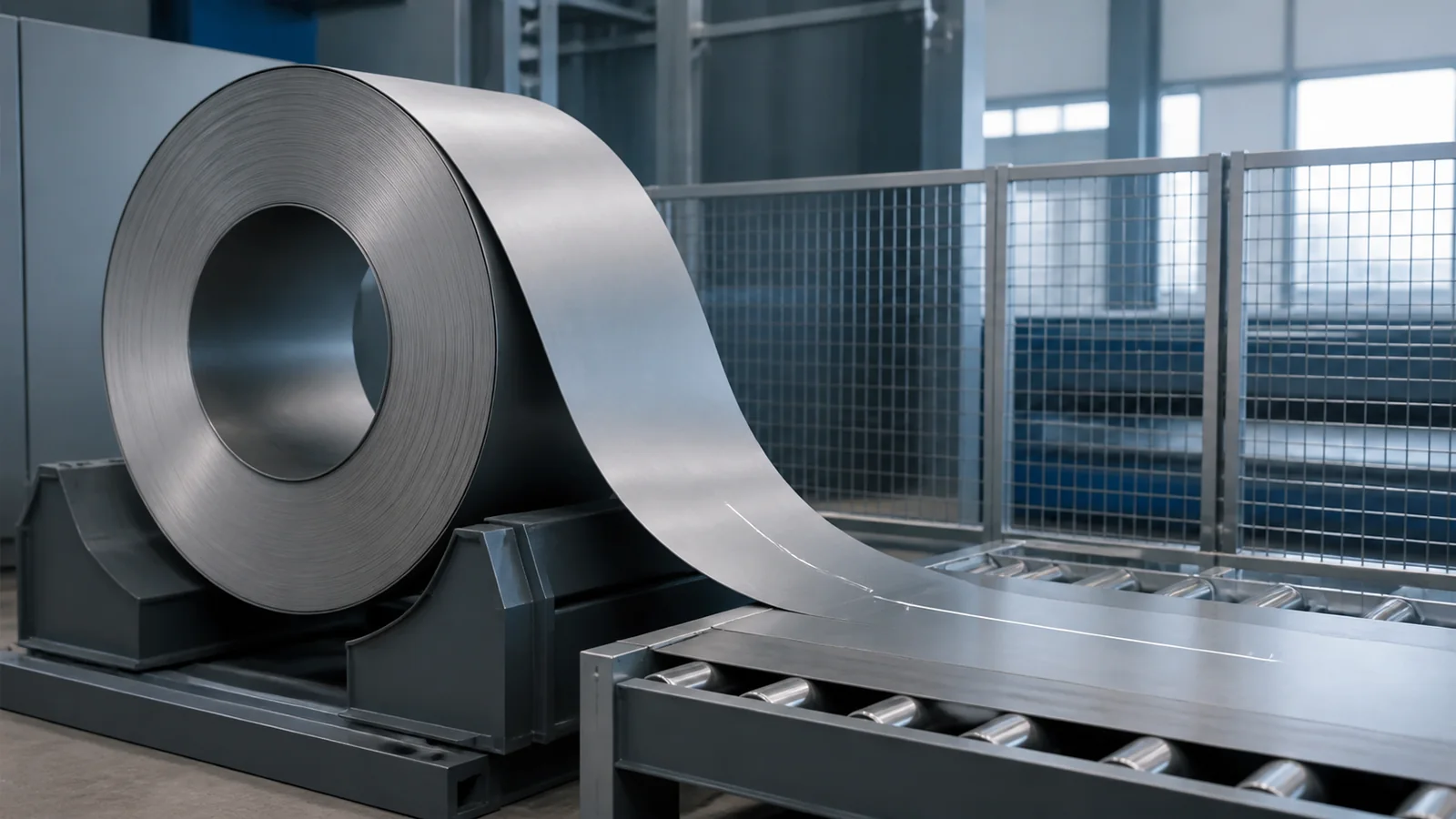
Identify the metal mass and strip geometry
Weight-to-length needs four inputs: coil metal mass, nominal strip thickness, nominal strip width and density. Check that the weight excludes whatever the calculation should not treat as strip, such as external packaging or a separately counted pallet. Then enter the final usable width, not an unslit parent width, when the question concerns the length of a slit mult. Matching the input definitions to the production question matters more than choosing a convenient nearby example.
The 310S / 1.4845 selection uses 7,800 kg/m³. For every other grade, enter a density confirmed from the applicable material document. There is no single stainless density that fits every grade. Save the density reference with the worksheet because any proportional error in density becomes an inverse error in estimated length.
Divide mass by mass per metre
First find the flat metal volume in one metre: thickness in metres multiplied by width in metres multiplied by one metre. Multiplying that volume by density gives kilograms per metre. Dividing confirmed coil metal mass by kilograms per metre gives theoretical strip length. This is the inverse of calculating strip weight from a known length, so the two calculations provide a useful cross-check.
For 1.5 × 1,000 mm strip at 7,800 kg/m³, one metre weighs 11.7 kg. Dividing 2,000 kg by that rate gives 170.94 m. Keeping both steps visible helps catch unit errors: thickness must be converted from millimetres and width must describe the strip whose length is required.
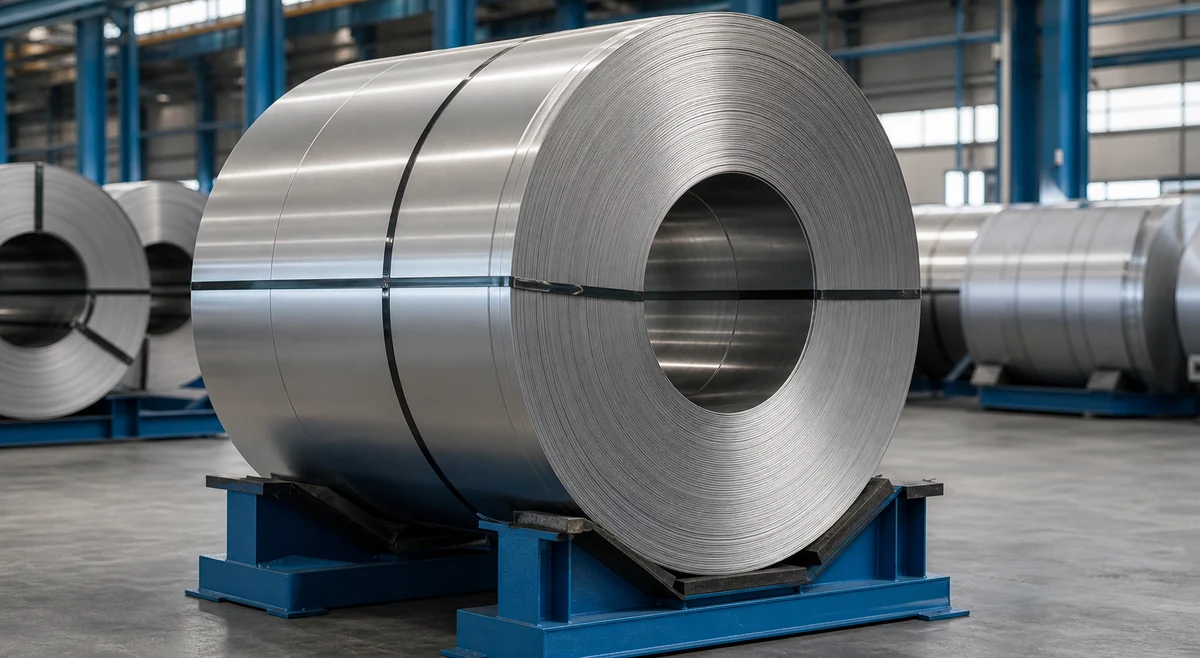
Reconcile 2,000 kg of 1.5 × 1,000 mm strip
Choose weight-to-length mode, select 310S and enter 2,000 kg, 1.5 mm thickness and 1,000 mm width. The result is 170.94 m. As a cross-check, one metre weighs 11.7 kg, and multiplying that rate by the calculated length returns the entered metal mass apart from display rounding.
Suppose the planned good-product run is 150 m at the same nominal geometry. That length requires 1,755 kg of theoretical metal, leaving the difference between the entered coil mass and run demand for separately documented setup, sampling, head and tail, edge or contingency planning. Production should set the yield allowance from its actual route, equipment and quality plan.
1.5 × 1,000 mm, 2,000 kg
Using 7,800 kg/m³, the strip has a theoretical mass of 11.7 kg per metre, so 2,000 kg corresponds to about 170.94 metres before processing loss or measured-thickness effects.
The example uses the 310S / 1.4845 preset density of 7,800 kg/m³. For another grade, enter the density stated in the applicable material document.
The figures are theoretical results from nominal inputs. Actual dimensions, tolerances and the agreed commercial basis determine delivered or invoiced weight.
Compare six weight-to-length calculations
The table spans 0.5 to 3.0 mm thickness, 600 to 1,500 mm width and 1,000 to 10,000 kg metal mass. Each displayed length follows from the inputs in its row. Comparing rows illustrates how more cross-sectional metal reduces metres available from a given mass, but the changing masses mean the table is not a simple ranking by thickness.
Treat each row as a labeled scenario, not as an availability statement or standard coil program. If an offer lists 1.48 mm measured thickness against a 1.5 mm nominal requirement, do not quietly replace one with the other; decide which basis answers the planning question and record it. Likewise, use the ordered slit width for a strip run, and reconcile how a parent coil's width is allocated across strands, edge trim and any unslit remainder.
| Example | Coil weight | Thickness | Width | Density | Theoretical length |
|---|---|---|---|---|---|
| 0.5 × 600 mm, 1,000 kg | 1,000 kg | 0.5 mm | 600 mm | 7,800 kg/m³ | 427.35 m |
| 0.8 × 1,000 mm, 2,500 kg | 2,500 kg | 0.8 mm | 1,000 mm | 7,800 kg/m³ | 400.64 m |
| 1.0 × 1,250 mm, 5,000 kg | 5,000 kg | 1.0 mm | 1,250 mm | 7,800 kg/m³ | 512.82 m |
| 1.5 × 1,000 mm, 2,000 kg | 2,000 kg | 1.5 mm | 1,000 mm | 7,800 kg/m³ | 170.94 m |
| 2.0 × 1,500 mm, 10,000 kg | 10,000 kg | 2.0 mm | 1,500 mm | 7,800 kg/m³ | 427.35 m |
| 3.0 × 1,200 mm, 7,500 kg | 7,500 kg | 3.0 mm | 1,200 mm | 7,800 kg/m³ | 267.09 m |
Connect theoretical length to slitting and production
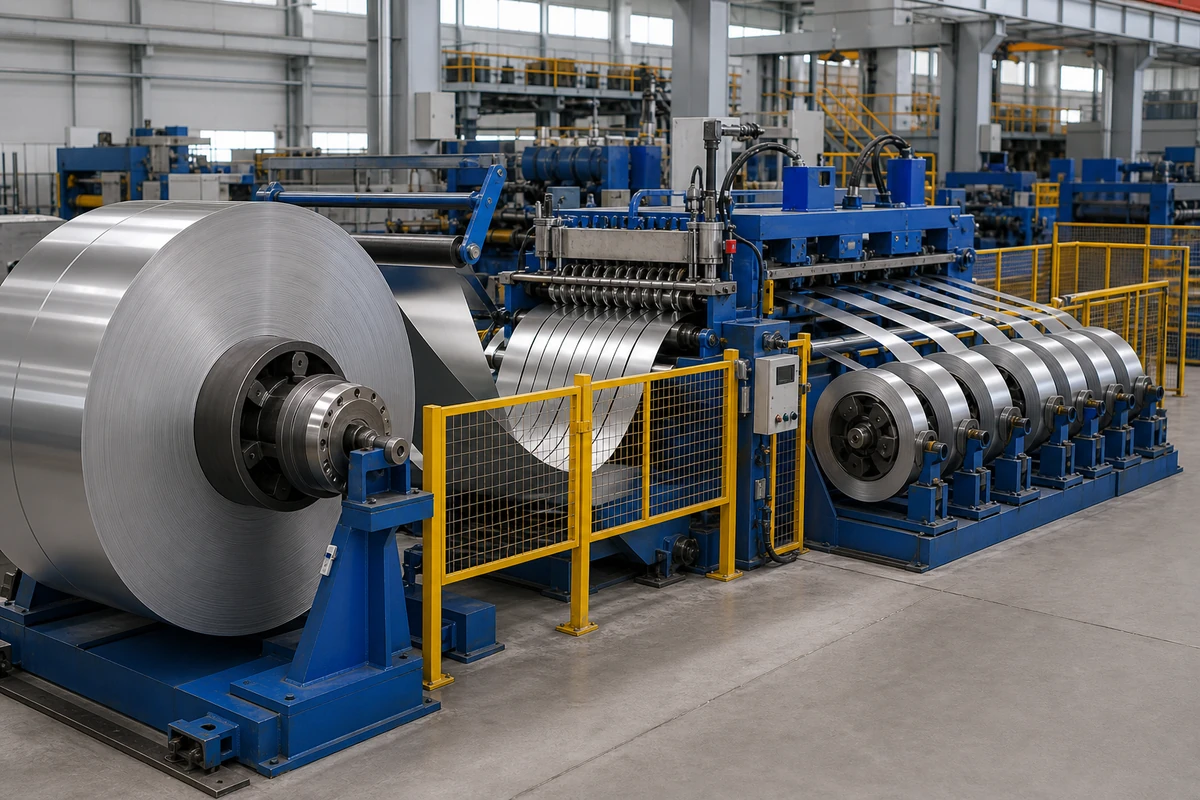
For slit material, width is both a calculation input and a yield decision. A parent coil may be divided into several slit widths plus edge trim. Each strand can share approximately the parent travel length, but saleable mass and usable length depend on the confirmed slitting plan, finished widths and process loss. Ask the supplier to identify parent-coil reference, slit mult arrangement, number of resulting coils and target weight distribution when continuity matters to production.
Convert the required production metres back to theoretical mass as a demand check, then add a separately approved allowance. This distinguishes calculated good-product metal from process planning rather than hiding both inside an unexplained heavier coil request. If one continuous run is essential, specify minimum usable length or coil-break restrictions and ask how the supplier will document them. Total mass across several coils does not guarantee that any single coil contains the continuous length needed.
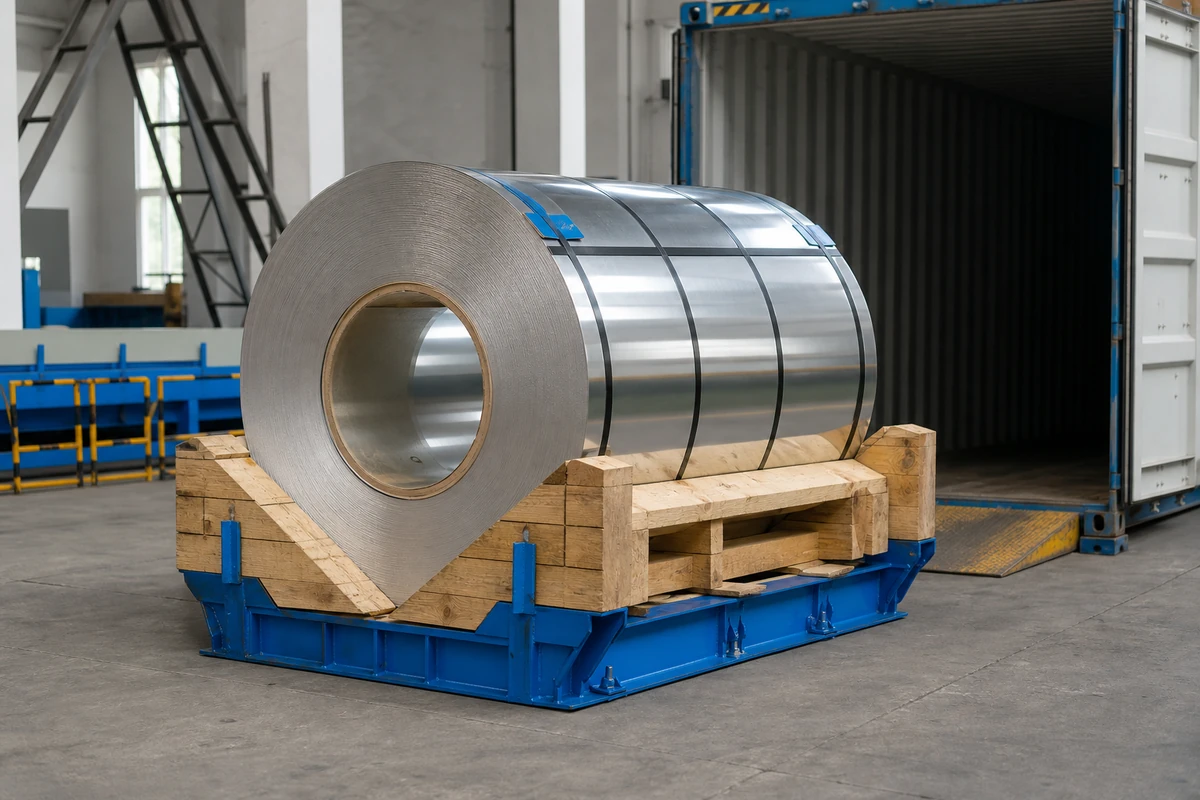
Weight also drives logistics. Request individual coil net mass, package gross mass, coil count, orientation and handling details needed by the receiving site. The calculated strip length cannot determine pallet mass, wrapping, eye orientation, lifting equipment or vehicle loading. Compare the heaviest proposed package with site limits and preserve margin for the actual shipment information; do not treat theoretical metal mass as a lifting certificate or gross transport weight.
Keep flat-volume length separate from coil OD
Weight-to-length uses flat metal volume, so it does not need outside diameter, inside diameter or winding tightness. An OD estimate is a different geometric problem. Real winding can include interwrap gaps, telescoping, crown or thickness profile, and the core occupies the center. Those conditions can affect measured OD and package envelope without changing the ideal flat-volume relationship used here. Do not reverse an observed OD into a guaranteed strip length unless the agreed method accounts for the relevant winding conditions.
Clarify whether the stated coil weight is gross, net, theoretical or scale weight and whether the core is included. Commercial documents may use a basis that differs from the metal-only input required for this calculation. Nominal thickness also differs from measured thickness data, which can shift an inferred length. Ask the supplier to state the quotation, packing-list and invoice bases, then choose inputs consistent with the decision being made rather than mixing values from different documents.
Prepare a coil RFQ with length and mass
Provide grade and designation, product form, governing standard, thickness, finished width, requested metal mass or target usable length, coil count preferences, inside-diameter requirement, maximum acceptable package values, surface and edge requirements, slitting or cut-to-length scope, inspection documentation and destination. Include the calculator result as a labeled planning estimate and ask the supplier to confirm the proposed coil breakdown and commercial weight basis.
Before release, rerun the final offer dimensions and weights. Verify density against the applicable document, reconcile slit width with the mult plan, and compare theoretical available length with the production run plus its approved allowance. Confirm which values will appear as net and gross weights on shipping documents. If outside diameter matters for a payoff reel or storage rack, request it separately and review the supplier's winding assumptions rather than deriving a firm OD from ideal flat volume.
Prepare your quote request
Frequently asked questions
How should slitting or cut-to-length loss be added?
The calculator returns flat geometry-and-density length. Add setup, sampling, head and tail, edge trim and other route-specific allowances separately using the confirmed production plan.
Can gross shipping weight be used as coil metal weight?
Only after confirming which non-metal or separately counted items are included. Use the metal mass appropriate to the calculation, and keep pallet, wrapping, core treatment and other gross-weight components explicit.
Can coil OD prove the available strip length?
Not by itself. Core diameter, interwrap gaps, crown, telescoping and winding condition can affect OD. Use confirmed metal mass, thickness, width and density for this flat-volume estimate.
How do thickness and width affect length from a fixed coil weight?
At the same metal mass and density, greater thickness or width means less calculated length. Use the dimensions of the material being purchased, not dimensions copied from another coil.