
Before your stainless steel leaves the supplier, check that the goods, certificates and packing list match your order. This checklist helps you spot mismatched heat or lot references, missing inspection records and packing problems before dispatch. Before release, check the finished goods and required records against the purchase order, applicable product standard, current approved drawings, and agreed inspection and packing requirements. Include any approved changes that apply to the shipment. The final check should cover material identity, dimensions, surface and processed geometry, quantity, weight records, material and inspection documents, packing and labels. Keep any open nonconformity on hold until the authorized party has approved how it will be handled and the resulting action and final status have been recorded.
Quick Facts for Buyers
- Confirm which documents govern inspection
- Before inspecting the goods, assemble the documents that define acceptance.
- Match material identity from the order to the goods
- Check the ordered grade or designation, product standard, product form, delivery condition and nominal dimensions against the material documents and physical goods.
- Inspect dimensions, surface, edges and processed geometry
- Use the acceptance limits and measurement methods specified in the product standard, drawing and order.
- Check the documents for this shipment
- Create a document index for the actual shipment rather than relying on a folder of unlabelled files.
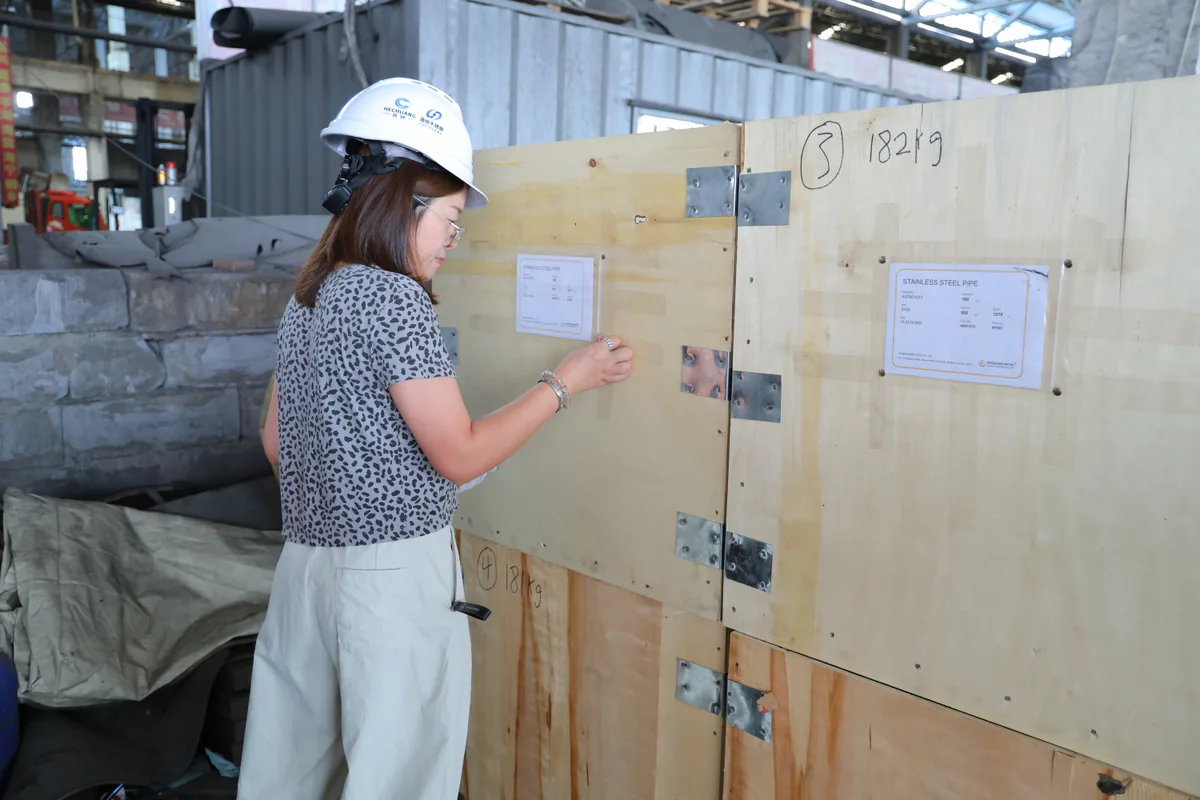
Confirm which documents govern inspection
Before inspecting the goods, assemble the documents that define acceptance. The inspection team should be able to identify the current revision of each requirement without choosing between conflicting emails or drawings.
Use the documents that apply to the order:
- purchase order and line-item description;
- governing product standard and edition;
- approved drawing, bill of materials or data sheet;
- agreed inspection and test plan (ITP), including any witness or hold points;
- approved technical clarifications, deviation permits and concessions, as applicable;
- processing, marking, packing and label requirements; and
- document-submission and release requirements.
Remove superseded revisions from the working inspection pack or mark them clearly as obsolete. If the quotation, purchase order and drawing use different requirements, stop and resolve the conflict before release.
Match material identity from the order to the goods
Check the ordered grade or designation, product standard, product form, delivery condition and nominal dimensions against the material documents and physical goods. Follow the agreed heat or lot identifier through the material certificate, product marking, bundle or piece tag, inspection records and packing list.
When cutting, slitting or machining has separated material from its original mark, use the transferred identification or material map required by the order. For small parts or mixed packages, the packing record should preserve the link to the correct heat, lot or controlled batch.
For example, if an order requires heat traceability and a shipment contains 310S plates from two heats, the packing records should show which tagged group belongs to each heat. Match each group to the relevant certificate before release. A packing-list entry showing only the grade and total quantity is not enough for that check.
A visible grade mark is one useful link in the identity chain. Release still depends on agreement among the order, the applicable material record, the marking and the goods.
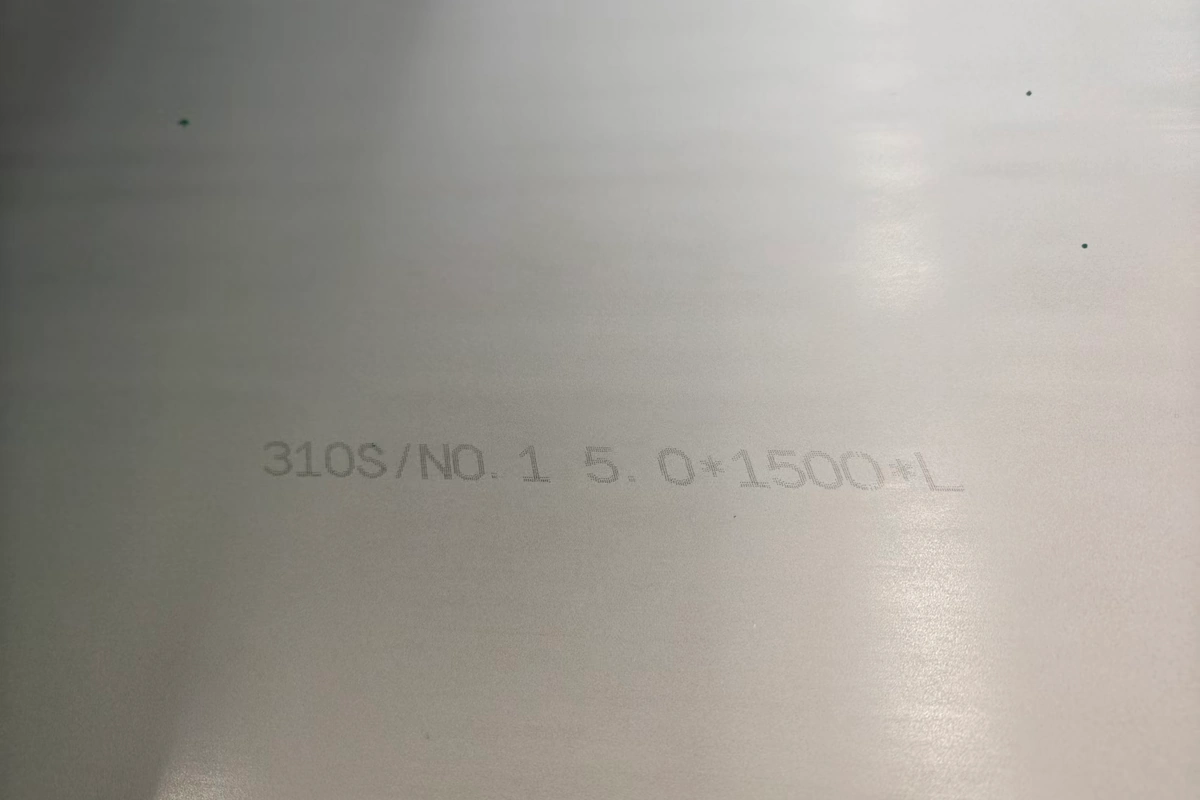
Visible 310S marking on a stainless steel sheet. For release, verify the marking against the material certificate and order records.
Inspect dimensions, surface, edges and processed geometry
Use the acceptance limits and measurement methods specified in the product standard, drawing and order. If a dimensional report is required, identify the inspected item or sample, instrument or method, and sampling basis where applicable. Show the actual readings beside the acceptance limits so the buyer can connect the results to the goods.
For unprocessed material, the check may include thickness, width, length, outside diameter, wall thickness, straightness, flatness, finish and edge condition. For processed goods, use the approved drawing revision to check cut size, hole location, bevel, formed geometry, machining allowance, orientation and other ordered features.
Inspect visible surfaces and edges for the acceptance conditions named in the order. Check for handling damage, contamination, dents, scratches, edge damage, film condition or other features that matter to the specified finish and next manufacturing step. Where appearance matters, agree written acceptance limits or a reference sample before inspection.
Positive material identification (PMI), hardness testing, ultrasonic testing (UT), liquid penetrant testing (PT) and other examinations are not automatic requirements for every stainless steel shipment. Include the examinations required by the governing product standard, project specification or purchase order. If additional testing is used to investigate a quality concern, define its scope and retain the results. Confirm the method, coverage, sampling, acceptance criteria, timing and reporting requirements before testing. A third-party inspection is also an agreed service, not a default step for every shipment.
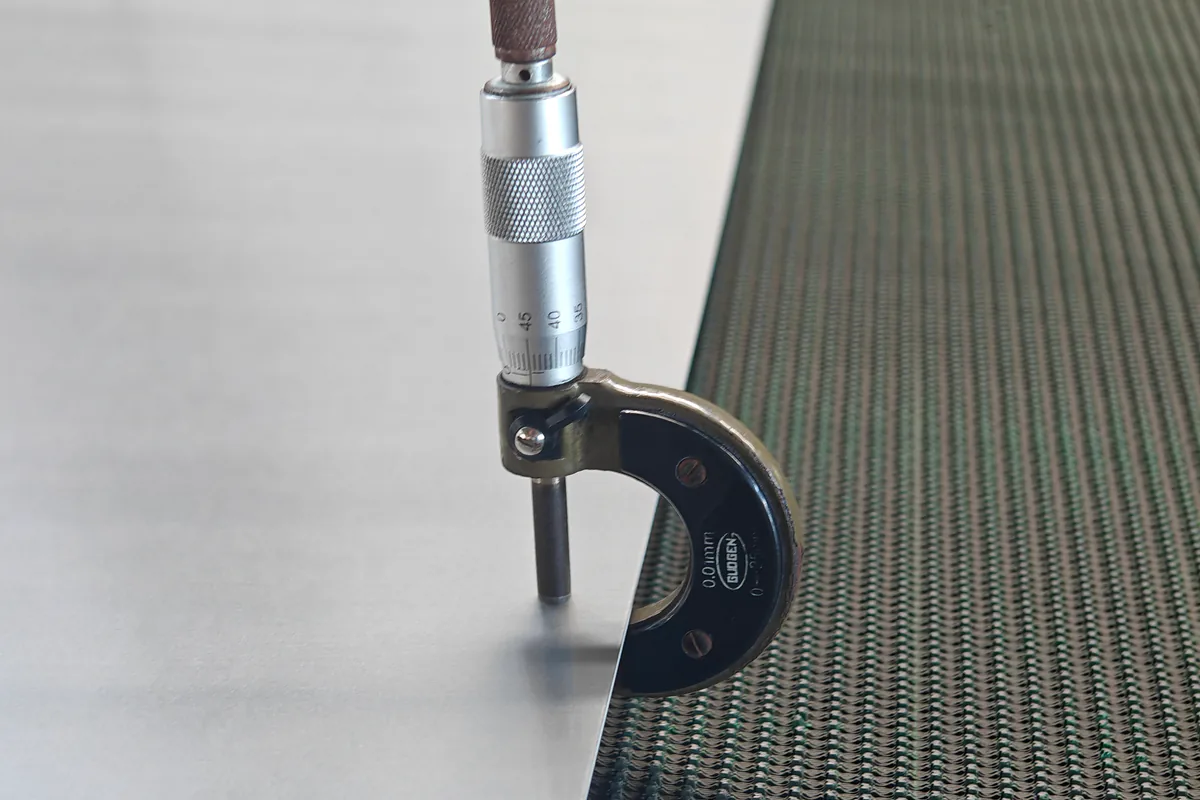
Micrometer check on flat stainless steel. Use the specified measuring points and record the actual readings when a report is required.
Reconcile quantity, package count and weight records
Count the finished pieces, plates, coils, bundles, tubes, bars, parts or other ordered units. Then match that count to package identifiers and the packing list. For partial shipments, identify which purchase-order quantity and which heats or lots are included in the release.
Keep weight terms clear:
- Net weight is the weight of the goods under the stated measurement or commercial basis.
- Gross weight includes the goods and the applicable packaging, supports and protection.
- Theoretical weight is a calculated value based on dimensions and density. It should not be substituted for a measured value when the order or shipping record requires actual weight.
The release record should identify the basis for each required weight, the weighing or calculation record used and any agreed tolerance or reconciliation method. Package count and gross weight should also agree with the packing list and labels where those fields are required.
Check the documents for this shipment
Create a document index for the actual shipment rather than relying on a folder of unlabelled files. Depending on the order, the release package may include:
- the required material test certificate (MTC) or other specified inspection certificate;
- supplementary test reports;
- dimensional, surface or processing inspection records;
- traceability or material-mapping records;
- an inspection release note or certificate of conformity when ordered;
- the packing list and package-weight record;
- approved deviation or concession records; and
- third-party reports or endorsed inspection records when the service was specified.
Check that the document numbers, revisions, pages and identifiers are complete and legible. Each report should connect to the correct purchase-order line, item, heat, lot, piece or package at the traceability level required by the order.
The phrase “MTC” does not by itself define the inspection-document type. Use the stainless steel MTC and EN 10204 3.1 guide to set and review the document requirement. This shipment checklist does not replace that document review.
Verify packing, protection and labels
Compare the finished package with the agreed packing plan for the product form, handling method, route and destination. Checks may include wrapping, separators, edge or end protection, timber supports, skids, saddles, bands, lifting points and crate condition where these features are specified.
Keep carbon-steel strapping and supports separated from stainless steel surfaces with suitable protective material, and check for loose iron debris before packing.
Labels and marks should remain readable and should identify the fields required by the order. These may include the purchase-order line, item or package number, grade, size, quantity, heat or lot reference, net or gross weight, handling marks and destination mark. Include only the fields required by the order, carrier and destination rules.
ASTM A700-14(2019) is an active guide for packaging, marking and loading steel products for shipment. Apply it when it is specified in the purchase documents or otherwise agreed for the order. The agreed purchase documents and destination requirements still define the package to be released.
Wooden export crates in a warehouse. Confirm crate construction, supports, protection and labels against the agreed packing plan.
Control nonconformities before release
A nonconformity means that a specified requirement has not been met. In ISO quality terminology, a concession permits the use or release of a specific nonconforming product, while a deviation permit approves a departure from a specified requirement before the relevant work is carried out. The purchase order and project procedure should define the terms, authority and approval route that apply to the order.
Use this sequence for any open item:
- Identify and hold. Mark and segregate the affected goods, package or document set. Record the purchase-order line, item identity, heat or lot, quantity affected and the requirement involved.
- Review and approve the disposition. Compare the actual condition with the current standard, drawing, order and approved clarifications. Obtain the technical or commercial authorization required for concession, document correction, rework, repair, replacement or rejection.
- Carry out the approved action. Complete the authorized document correction, identification restoration, rework, repair, repacking, relabelling, replacement or segregation. A concession may not require physical rework, but its scope and approval still need to be recorded.
- Reinspect where required. Repeat the affected check and record the result required by the approved disposition. Reinspection should address the original issue and any related change introduced by the action.
- Record the final status. Link the disposition, completed action and reinspection evidence to the affected quantity. Record whether it is released, remains on hold or is rejected. Do not ship against an open item simply because a verbal agreement is expected later.
If the issue affects only part of a shipment, the release record should clearly separate released and held quantities. Do not allow a corrected document for one heat, lot or package to close a different open item.
Define who checks and who releases
The responsible parties should be named before processing begins. Their roles can differ by contract.
| Party | Typical responsibility before shipment | Release boundary |
|---|---|---|
| Supplier | Prepare the goods, complete the agreed checks, maintain identification, compile the document index, report nonconformities and complete the approved disposition | Records supplier release or readiness only within the authority stated in the order |
| Buyer | Define the acceptance basis, review required submissions and decide deviations or concessions where the contract assigns that authority | Records buyer approval or authorization when required; the supplier should not assume it from silence |
| Appointed third party | Perform or witness the specified inspection points and issue the agreed report or endorsement | Reports findings within the appointed scope; it does not approve an engineering or commercial deviation unless the contract explicitly grants that authority |
A witness report, MTC, test report and shipment-release record serve different purposes. The inspection plan should state which records are evidence and which approvals are still needed before the next step.
Shipment inspection checklist you can copy
Use this checklist as a starting point for the purchase order, ITP or final release record. Replace the bracketed fields with the actual project requirements.
Order / PO: [Reference]
Shipment / batch: [Reference]
Inspection date: [Date]
| Check | Acceptance basis | Evidence / record reference | Responsible party | Status or disposition |
|---|---|---|---|---|
| Current order basis | Latest approved PO, product standard and edition, drawing revision, ITP, packing specification and approved departures | Controlled document list or transmittal reference | [Name / role] | [Pass / Hold / N/A] |
| Material identity and traceability | Ordered grade, product standard, form, condition and required heat or lot traceability | Certificate, markings, tags, transfer record and packing link | [Name / role] | [Pass / Hold / decision reference] |
| Dimensions | Product standard, drawing, order tolerances, measurement points and sampling basis | Report number, readings and instrument record when required | [Name / role] | [Pass / Hold / reinspection] |
| Surface, edges and processed geometry | Written surface criteria, approved drawing, reference sample or agreed processing acceptance | Visual or dimensional record; photo reference if permitted | [Name / role] | [Pass / Hold / rework] |
| Quantity and package count | PO quantity, approved partial-shipment plan and packing instructions | Count sheet, packing list and package IDs | [Name / role] | [Pass / Hold / quantity decision] |
| Net and gross weight | Ordered commercial basis, packing plan and stated weighing or calculation method | Scale record, calculation sheet and packing list | [Name / role] | [Pass / Hold / reconciliation] |
| Material, test and inspection documents | Required document types, results, language, revision and submission timing | Document index, certificate and report references | [Name / role] | [Complete / Hold / correction needed] |
| Packing, protection and labels | Agreed packing, handling and destination requirements | Checklist, label record and photo reference if permitted | [Name / role] | [Pass / Hold / repack or relabel] |
| Open nonconformities | Order-defined disposition authority and closeout procedure | Record number, written disposition, action and reinspection reference | [Name / role] | [Closed / Hold / Reject] |
| Final shipment release | Required checks complete for the released quantity; goods still on hold segregated and excluded from shipment; hold lifted only after the approved disposition is carried out and the release decision is recorded | Signed or recorded release reference | [Name / role] | [Released / Partially released / Not released] |
Illustrative example for a two-heat traceability hold
This is a teaching example, not a customer or shipment record. It assumes that the order requires heat traceability and the corresponding certificate for each heat.
| Example field | Example entry |
|---|---|
| Finding | The shipment includes 310S material from two heats, but the document package contains the required certificate for only one heat. |
| Current status | Keep the material linked to the missing certificate on hold and identify the affected quantity. |
| Evidence needed to close | Obtain the missing certificate, match it to the relevant material and record the final release status authorized under the order. |
Frequently asked questions
Is pre-shipment inspection the same as reviewing the MTC?
No. The MTC or inspection certificate is one part of the evidence package. Pre-shipment release also checks the governing order documents, physical identity, dimensions, surface, processed geometry, quantity, weight records, packing, labels and any open nonconformity.
Are PMI, UT or PT required for every stainless steel shipment?
No. PMI, UT and PT are not automatic requirements for every shipment. Carry out the examinations required by the governing standard, project specification or purchase order. Additional testing may also be used to investigate a quality concern; define the scope and retain the results. Agree the method, coverage, sampling, acceptance criteria, timing and reporting requirements before testing.
Can goods ship while a nonconformity is still open?
The affected goods should remain on hold until the order-defined authority has issued a written disposition and any required correction and reinspection are complete. A partial shipment can release unaffected goods only when the records clearly separate released and held quantities.
Who should sign the shipment release?
The purchase order or inspection plan should name the responsible function. The supplier may record its own readiness, while the buyer or an appointed third party may have additional review or release roles. A third-party report does not automatically authorize a deviation or commercial release.
How should partial shipments be controlled?
Give each shipment a clear package list and release status. Identify the purchase-order quantities, heats or lots, documents and packages included. Later documents should not silently replace the records used for an earlier shipment.
What should I ask the supplier to send before I approve shipment?
Ask for the shipment-specific packing list, required material certificates and inspection reports, and records showing how any nonconformities were closed. Where agreed, request package and marking photographs. Check that the package IDs and heat or lot references match across the records.
Technical Sources
Technical references apply to the material designation, product form and condition described here. They do not certify an individual delivery; the order and material certificate identify the supplied material.
- ASTM International — ASTM A700-14(2019)
- DIN Media / DIN Deutsches Institut für Normung e. V. — DIN EN 10204:2005-01 — Metallic Products — Types of Inspection Documents
- International Organization for Standardization — ISO 9000:2026
- World Stainless — Erection and Installation of Stainless Steel Components
Discuss your material and inspection requirements
For a stainless steel enquiry, send your grade, product form, dimensions and quantity, plus any inspection or packing requirements you already have. Hechuang can confirm the checks, documents and packing scope for the proposed supply before you place the order.